

What Streams May Come: Navigating Vincent Ward’s ‘River Queen’
What Streams May Come: Navigating Vincent Ward’s River Queen
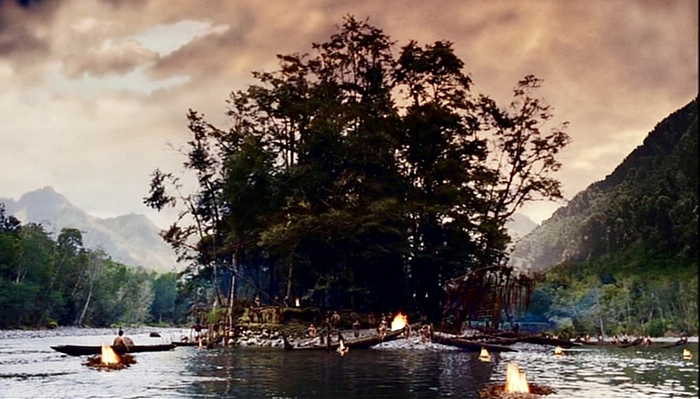
The mighty Whanganui River which courses through the narrative
1 ‘Our Story’ Lessons
Vincent Ward’s version of the most culturally resonant New Zealand film genre, the New Zealand Wars Epic, like its predecessors, Hayward’s The Te Kooti Trail (1927), his two versions of Rewi’s Last Stand (1925; 1940), and Geoff Murphy’s Utu (1983), remythologises history for its age. Hayward’s films, the earliest reimagining the wars only half a century on through the lens of optimistic settler dreams of racial reconciliation after heroic misunderstandings, were the primary cinematic texts of a period of seeming cultural rapprochement, their contradictions both clustered in and obscured by the figure of the mainstream’s Pakeha Maori hero (Ropata Beaumont’s, Gilbert Mair’s and Eric Mantell’s attainment of settler indigeneity underwritten by Maori borrowings). Murphy’s Utu embodied the 1980s breakdown of the dream of the slowly evolving new race of New Zealanders in the epigraph to the second Rewi’s Last Stand and in Gilbert Mair’s farewell letter to his Arawa kupapa in The Te Kooti Trail’s coda.
Embodying the disruptions of cultural dissonance and competing histories, Utu even found more quirkily ambivalent texts from Hayward’s muse, the New Zealand Wars’ historian, James Cowan, to rework. In the enigmatic kupapa, Wiremu (Wi Kuki Kaa, whose appearance as Rangi in River Queen, shortly before his death, provides one of many links between the films) it found its symbolic end and new beginning in the Maori who difficultly loves Pakeha rather than the older figure of the Pakeha who loves Maori, a trope destabilising Pakeha cultural predominance and suggesting growing Maori centrality for the 1980s.
More than 20 years on, Ward’s River Queen inherits recent revisionist history like Judith Binney’s Te Kooti (1) and James Belich’s Titokowaru (2) as well as ‘her story’/history, invoking Caroline Perrett and Ann Evans behind the film’s heroine Sarah O’Brien (Samantha Morton)(3). The end credits ‘acknowledge with respect the extraordinary lives, words and actions’ not just of Riwha Titokowharu, but of both women, adding that ‘our story could not be as it is without theirs’.
That statement is literalised by the heroine’s derivation from them, inflected by an Irishness neither had, palimpsesting Ann Evans’s nursing skills and the legend of her being taken blindfolded to heal Titokowaru onto Caroline “Queenie” Perrett’s transculturation (though filmically her childhood abduction is displaced onto Sarah’s son) with the historical character’s kidnapping as retaliation for her father’s desecration of a burial ground replayed by Sarah’s “Da” in the film.
River Queen also relates intricately to its cinematic ancestors as well as to their common literary ancestor Cowan whose account of the letter from Titokowaru (Te Kai Po [Temuera Morrison] in the film) declaring his ritual cannibalism to a “semi – friendly chief”, and explanation of his abandonment of the Tauranga-ika pa at the height of his success underlie key incidents in River Queen (4). Like its ancestors, Ward’s film presents complex fantasy images of bicultural adjustment, uniting the questing Irish heroine with her mixed race son, Boy (Rawhire Pene), and her dead Maori lover’s brother, Wiremu (Cliff Curtis), with Sarah wearing the chin moko she makes her son give her as a sign of “family”. The moko is a paradoxical symbol in that neither Wiremu nor Boy, at the film’s end a professional travelling tatooist, dressed as a fashionable Victorian gentleman, wear facial tatoos (though Te Kai Po, flouting historical literalness does). This family distribution of tatoos is, in its lack, a sign of Maori movement towards European culture,and, in its presence, with Sarah, of Pakeha movement towards Maori. These despite Boy’s earlier insistence that he will tattoo his face, and Sarah’s dislike of the moko as enforcing cultural immobility.
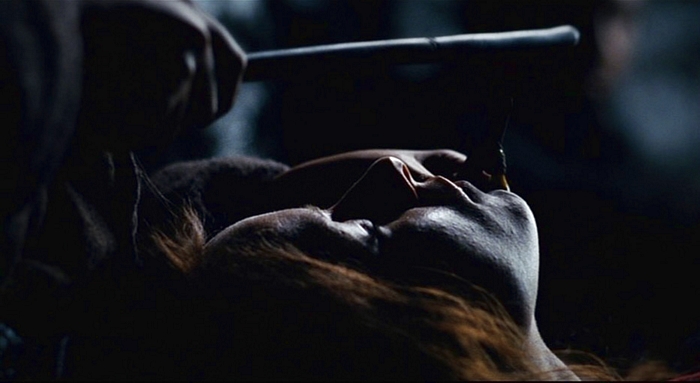
Sarah gets her son Boy to chisel her a chin moko
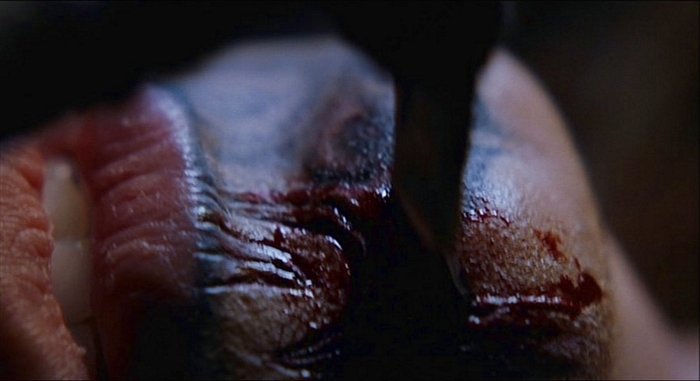
The painful process is part of a dense train of imagery connecting with bullet wounds and explosions of blood in the river
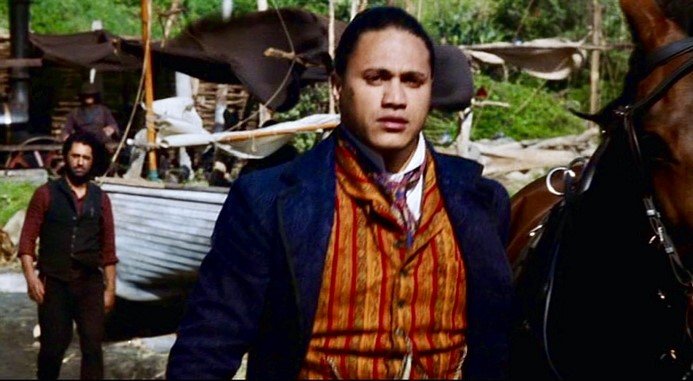
At the narrative’s close the now adult Boy, dressed like a fashionable Victorian gentleman settler, pursues the tattooing trade, though, unlike his mother, eschewing its marks on himself
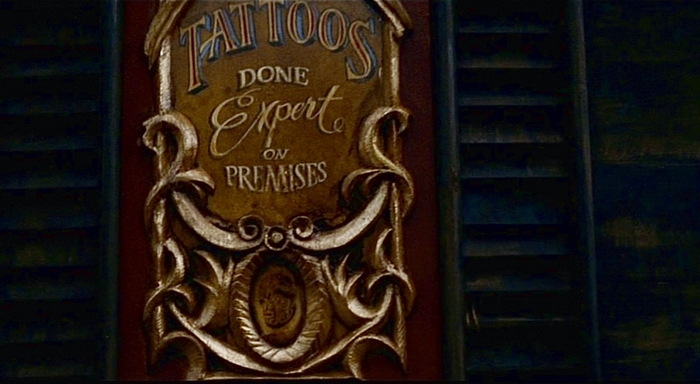
An example of the complexities attending on the film’s tattoo motif
Her tattoo’s painful chiselling references Te Wheke’s (Anzac Wallace) receiving the facial moko as a declaration of war in Utu, but here signifies unity. Though killed in a tragic misunderstanding by Wiremu, the kindly soldier Doyle (Kiefer Sutherland), with his unrequited love for Sarah, is a spectral member of this Celtic-Maori family (Sarah has said that he is the nearest thing to family she has left, and even undergoes a sort of platonic marriage with him, albeit interrupted by sexual congress with Wiremu, dressing for him in a wedding gown as he lies dying).
Ward’s film is ‘fabulous history’, its factual accuracy, in the classic American cinema’s tradition, resting in the reconstruction of period detail, uniforms and warfare, particularly the pa’s prefiguration of trench fighting strategy which has been much discussed lately, and extending, Ward claims, to the cast even learning 19th Century Maori dialects. There is a broader commitment to contemporary historical rewritings in the film’s continual invoking of revisionist views of the New Zealand Wars, but with its emphasis on dreams and visions (in this close to What Dreams May Come, Vigil, The Navigator, and Map of the Human Heart) always moving to oneiric and mythic latitudes. For instance, Titokowaru’s military genius at creating decoys is registered in the skipping girls who decoy the British soldiers and kupapa (5), but no historian prompted the images of Boy flitting through the forest, bewildering the attackers with misdirections in Scottish, English, and Irish accents, for all the world like Puck in A Midummer Night’s Dream and Ariel in The Tempest.
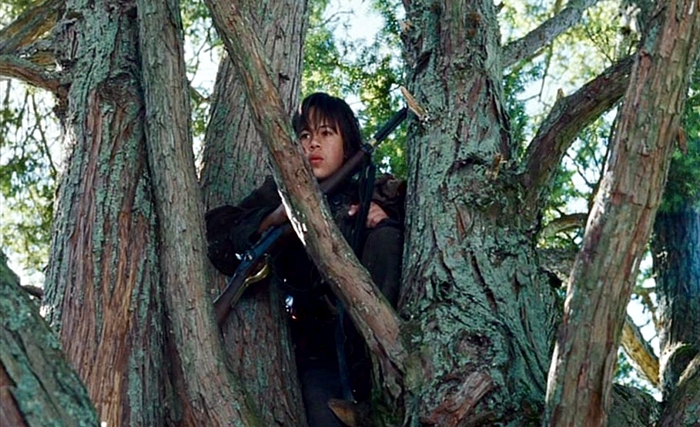
Boy, for all the world like Puck in A Midsummer Night’s Dream or Ariel in The Tempest
Given the historical films’ subject’s centrality – the national civil war epic – all of them from Hayward on, not unexpectedly, are major productions, made with unusual resources, even Hayward’s tiny ones unprecedented large-scale for early New Zealand productions. All subtextually embody hopes of cinematic as well as national renewal: e.g. Hayward’s assertion of local subjects being as vital as Britain’s and Hollywood’s; Murphy’s demonstration of a commercial New Zealand industry crossing local specifics with post-studio Hollywood kinesis; and Ward’s big budget return with the director making statements about New Zealand’s historical cinematic material so close to Hayward’s that the link must be conscious. Ward also demonstrates, as in lesser ways Murphy and Donaldson did contemporaneously, the now possible alternation of overseas film making with local production for expatriate film makers, as well as, in Ward’s case, so different from Murphy’s and Donaldson’s, the fusion of the art film with the more stylistically conservative local feature film. He also shows his mastery of the digital effects (in the title sequence’s dazzling scribble of water surface patterns, repeated at the close) now associated with the largest scale New Zealand cinema.
2. Ward, Griffith and (National) Histoire Sentimentale
In his book American Film Melodrama, Robert Lang quotes Godard’s hyperbole “Every article about the cinema ought to talk about Griffith”.(6) This article obeys that prescription, but argues a more specific connection. Ward’s formative New York trip to MOMA in New York to watch silents is probably thought to have been in pursuit of European art cinema only, but it is argued here that D.W.Griffith’s The Birth of a Nation and Intolerance were major parts of that – or of other experiences. Take what may be seen as an unflattering example. What Dreams May Come’s rebirth ending with its pretty children is irresistibly reminiscent of those at Intolerance’s close where the girl plants a hand kiss on the cheek of the boy who embraces her innocently. Even though Ward’s preference – interpreting his dvd commentary – was for a finale less overwhelmingly douce, the more roughly physical rebirths in America and Sri Lanka, the retained image’s Griffithian provenance suggests a seriousness beyond (though it may precariously straddle it) simple sentimentality, an attachment to the American cinema’s visionary melodrama tradition, a daring investment in the nakedly emotional, as much as in a sterner sublime.
Lang, like others, emphasises the family’s centrality to Griffith’s melodramas, something manifestly true too of Ward’s films as they oscillate between the (often ruptured) familial and the solitary. In River Queen the Griffith connection becomes undeniable, with its embracing of The Birth of a Nation’s conceit of the warring nation as divided family (though in Birth notoriously all white), culminating with characters from the split metaphorical family constituted by the Northern Stonemans and Southern Camerons meeting and clashing. This image of the family split by civil war exists in Hayward (most clearly in the second Rewi) whose early films so close in date, like Griffith’s Birth to the actual conflicts, are profoundly Griffithian, and even in Murphy’s more sceptical Utu, which, though it refuses to push the interracial love plot to centrality, in its narrative resolution reveals Te Wheke and Wiremu as brothers.
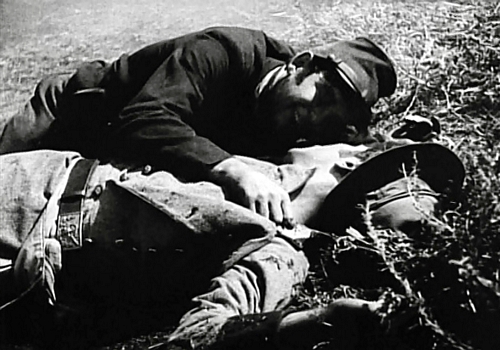
D.W.Griffith, The Birth of a Nation. As the subtitle ironically, with reference to the battlefield, says ‘True to their promise, the chums meet again’
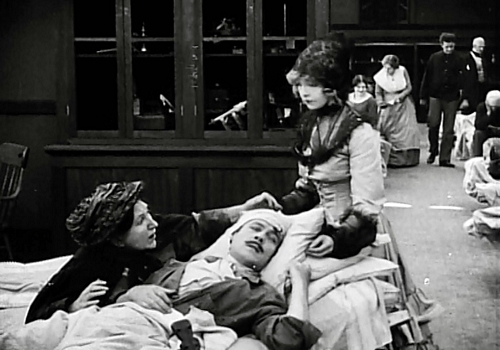
Families meeting across the divide; Mother Cameron, her son, the Confederates’ ‘Little Colonel’, and Elsie Stoneman, nursing him in the Unionist military hospital
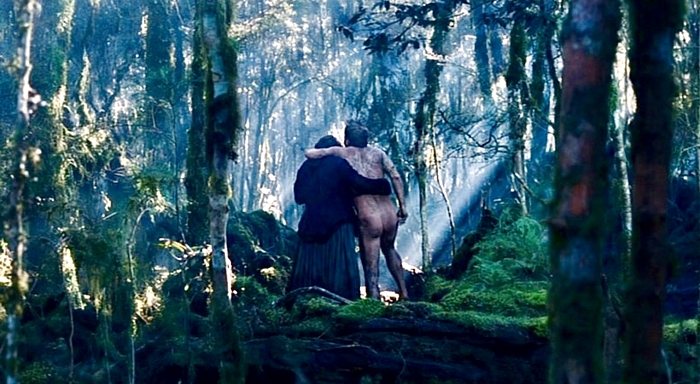
Sarah finds and rescues Doyle from the battle, one of several heightened meetings of literal and metaphorical family
At the furthest extreme from warfare depicted with only the most fragmented unsustained points of identification, e.g. Jansco’s The Red and the White, Griffith portrays historical forces fracturing families and lovers, a mode Ward embraces unconstrainedly. He combines similar harsh battlefield realism with paradigmatically melodramatic coincidence when, e.g. in mid combat, Doyle, encountering Boy, allows him to escape; when Wiremu, misreading him, tragically shoots Doyle; when Sarah wanders the bush in mid battle searching for Boy, then tends the stricken Doyle, at one point nearly shooting her son as, stripping corpses, he seems about to kill Doyle. Because of its concurrence with contemporary national ideologies, the “sentimentality” that some hostile local critics have chastised in Map of the Human Heart and What Dreams May Come is less likely to be raised over River Queen’s affirmations, but the nexus of sentiment, family, realism, and melodramatic coincidence is as deeprooted in Ward as in Griffith, though of course not fuelled by the same Victorian ethos. Ward is a visionary artist, attracted not just to the stern sublime dominant in his early films, but to antithetically extreme images of love and unity. As an extreme balancing act, his clashing inclinations pose problems, and may even risk bathos, but are always stylistically and thematically exciting.
3. Reworking The Searchers, Replaying The Piano
John Ford’s darkest western centres on the attempt led by Ethan Edwards (John Wayne) to rescue an adolescent girl, Debbie (Natalie Wood), abducted by the Comanche chief, Scar (Henry Brandon), seven years before. River Queen’s broad, inverted relation to this canonical quest narrative (female replacing male quester, male replacing female quested) is most concentrated at such moments as Ethan twice seeming about to kill Debbie to extirpate her interracial pollution, and where Ethan and Martin (Jeffrey Hunter), looking for Debbie among rescued white females, come across a traumatised mother and her two daughters, the daughters with tribal markings on their faces, one plainly insane. The racially obsessive side of Ethan in Ward’s film takes the shape of Major Baine, based loosely on the historical Lieutenant Colonel Thomas McDonnell (7) who in a metamorphosing of The Searchers into a New Zealand captivity narrative frame, shows Sarah a white woman, being pelted by settlers, who believes, McDonnell says, that because her husband is a native, she is a native, declaring of her transcultural transgression, “Madness is the only end for a woman like her”. Ward’s film also reworks his memory of Ford’s native abductor, Scar, in its reiterated emphasis, both visual and verbal, on scars – on Boy’s knee, the bayonet marks on Wiremu’s torso, his scarred trigger finger, the scar left by a bullet on Sarah’s neck, Sarah saying late on in the narrative, “Now it is easy to sleep on my old, old wounds”, and her father’s opening words about bullet wounds making a small wound going in but a large one coming out, repeated by Sarah later on. It also vividly reminisces Ethan’s downhill pursuit of Debbie in River Queen’s chase sequence where the colonial and kupapa horsemen pursue Sarah, Boy, and Wiremu down a precipitous stony bank.
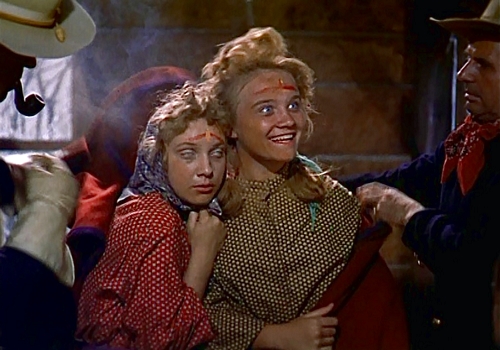
On Debbie’s trail the searchers find two rescued white girls with tribal markings, one of them clearly traumatised to madness
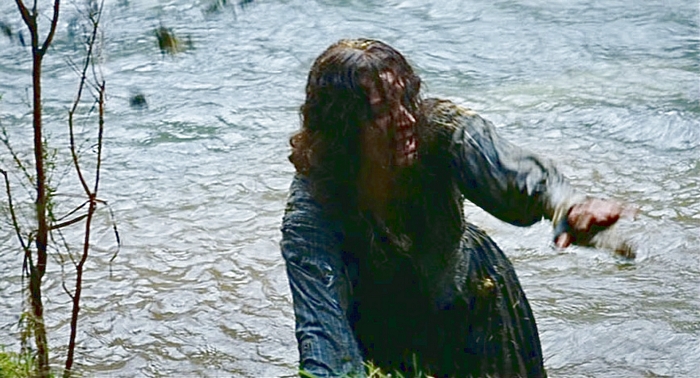
Major Baine in River Queen forces Sarah to look at a woman, who, after having “gone Bush” now believes she is “Native”, being pelted by colonists, with Baine seeing miscegenation ending in “madness”
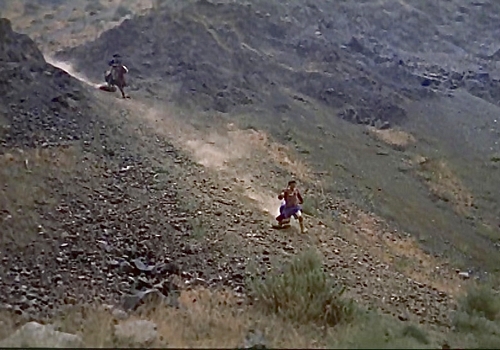
Images of Ethan’s pursuit of Debbie down that steep stony bank in The Searchers are also remembered in River Queen
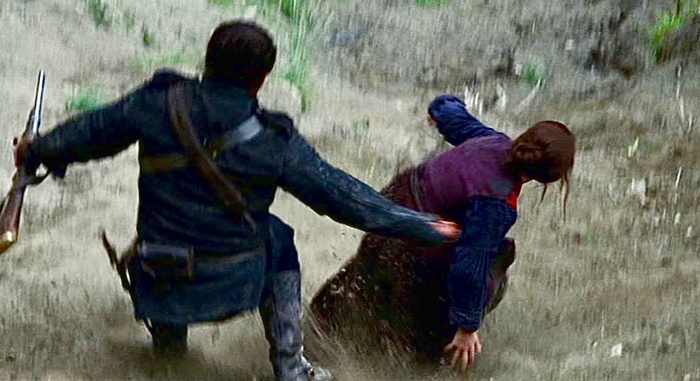
Sarah and Wiremu scrambling down the steep descent

pursued by the soldiers and kupapa
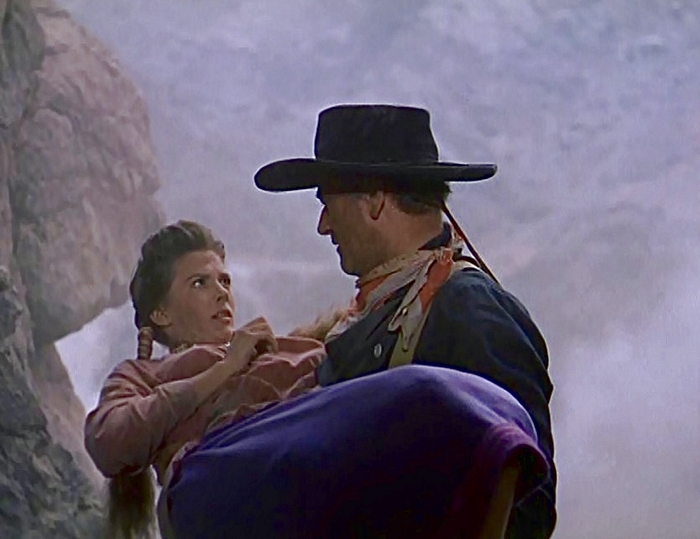
Climactic moment of part resolution as Ethan’s racial paranoia is about to relax and Debbie’s fear of him to subside, as what seems a distancing gesture, holding the polluted girl at a distance, becomes a cradling. Movingly, he tells her he is taking her home, a home which in a different time and place, can forgive her racial staining, but houses a wholly white family.
River Queen also interacts significantly with Jane Campion’s The Piano (1993). Both as mid-19th century female-centred narratives, privilege the heroine’s voice-over. Both centre on mother-child relationships, there that of Ada (Holly Hunter) and Flora (Anna Paquin); both end with a newly established family leaving the bush for a settlement life more ordinary (Nelson and River Queen’s small seaside settlement); Sarah’s monologue late in the film,“Far from my village there were stories traded around about a woman named Queenie who had crossed over to the Maori side” echoes the more arcane source of the beginning of Campion’s curious ‘book of the film’(8) to which Ward may have been drawn by the coincidence of both his and Campion’s attraction to extra-filmic commentary on their films – e.g. Ward’s Edge of the World with its various addenda to In Spring One Plants Alone, Vigil, and The Navigator. (9)
In both works water plays a major symbolic role, the ocean in The Piano, the river in Ward’s film along with the ocean at its beginning and end, invoking a mythic dimension connecting water, healing, death,and renewal. In River Queen think of the many panoramic shots of the Whanganui River winding endlessly through the landscape, its presence in Te Kai Po’s and Sarah’s shared dream, and the many moments where characters traverse it by canoe or boat, and even bodily enter into it. Sarah presides over Te Kai Po’s immersion cure; the chief, healed, calls up the river spirits; and Sarah, like a biculturalised river Nymph wades into the river in her wedding gown and looks at the reflection of her chin moko, just before being shot. The Piano attached some importance to Maoriness, with, for instance George Baines’ (Harvey Keitel) seemingly improvised facial tattoo and ability to speak the language signifying him as a kind of ‘Pakeha Maori’), though arousing some controversy at home in the way it colourfully backgrounded Maori, whereas River Queen foregrounds them. Such parallelisms and inversions are underwritten by shots near the beginning and at the end of Ward’s narrative which echo The Piano’s iconic images of the breakers rolling in. These allusions enclose the local cinema’s most famous melodrama within Ward’s visionary historical melodrama – paying homage but asserting difference.
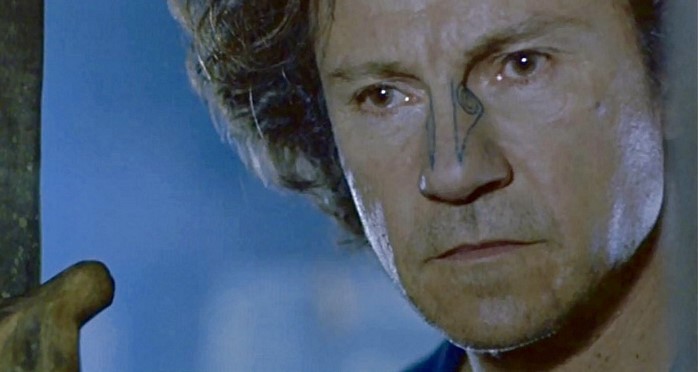
Baines’ idiosyncratic facial moko in The Piano
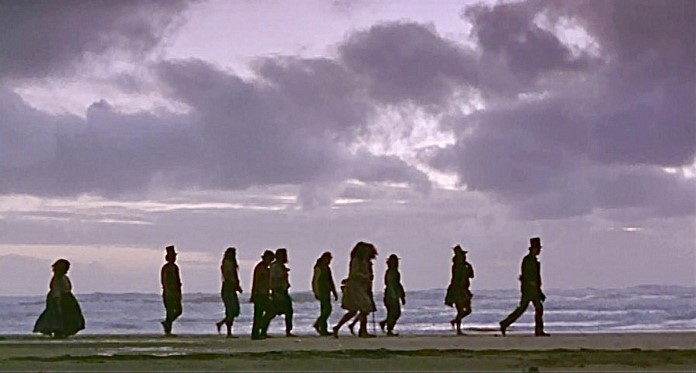
The memorable scenes by the ocean at the opening of The Piano
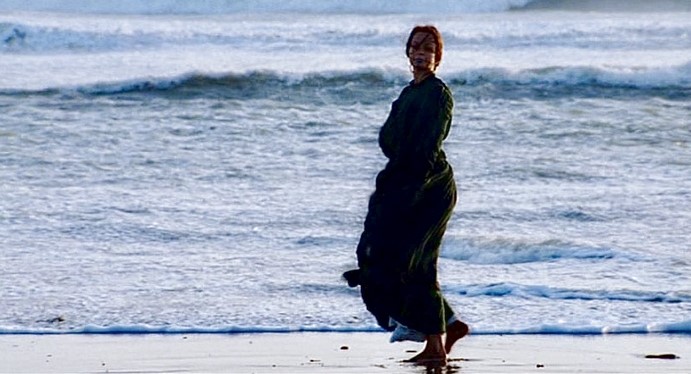
Sarah by the ocean at the close of River Queen
4. ‘The Pipes, the Pipes are Calling’
Music, important in Ward’s films multilayered designs, is prominent in River Queen, most heightenedly in its Irish songs, ‘Carrickfergus’, the bawdy, cynical ‘The Devil is Dead’, and the romantic ‘The Lady LeRoy’ droned by Doyle, as well as the Neo-Celtic ‘To Still My Mind’ (sung by the Scottish singer Mae McKenna), the leading motif in the film’s non-diegetic scoring. This shortlist omits, however, the most striking instance, ‘Danny Boy’, that anthem of exiled Irishness, its lyrics written as late as 1912 to ‘The Londonderry Air’ by an English lawyer and popularised in the USA by a German soprano’s recording. If we feel that Ward is aware of the lyrics’ anachronism and English derivation, then it adds a layer of self-consciousness to the film’s intensive use of Irishness. Like ‘Carrickfergus’’ lyrics of lost love and origins, ‘Danny Boy’ mourns both loss of lover and place. One of the film’s most memorable tropes is its being sung not only by Sarah, but in both English and Maori by Boy, so that it becomes a concrete aural repository of the film’s conceit of a bond between Irish and Maori – expressed literally when Doyle says that Wiremu is “one Maori that’s more like us Irish”. Like the Irish soldiers he began fighting against the British and ended up fighting for them, a parallelism augmented when he compares the ferocity of the Maori fighting the colonists to the Irish fighting Cromwell (10). Half of Ward’s ancestry is, as is well known, Irish, the other Jewish German, no doubt accounting for his interest in exile, displacement, and lost or strangely mingled origins – a point often made by the director himself.
This Irishness, like much else in the film, straddles reality – more than 40% of the British army in New Zealand were Irish Catholics, according to Belich (11) – and myth, with only Baines’ (Anton Lesser) Englishness clearly contradicting the almost unbroken identity of the film’s Pakeha. Irishness, like, say, American country music, confers an internationally appealing second metaphoric identity in New Zealand as elsewhere (who can resist the melancholy lilt of ‘Danny Boy’?). It provides a desirable image of Pakeha New Zealandness, a breath of romance, a solidarity with Maori as rebels (Sarah even refers to the Land Wars as “the Troubles”). The film complicates this and its idealisation of Titokowaru ‘s surrogate Te Kai Po, whose letter announcing his ritual cannibalism is made to seem only like a joke on credulous settlers – “That should warm them up a bit, shouldn’t it!” It vividly reflects the historical reality of Maori on Maori fighting, savage enough, especially with regard to Wiremu’s cousin Hone (Mark Ruka), to suggest that the epigraph explaining kupapa wholly in terms of an alternative land- saving strategy to rebellion, seems partial. Hone is Baines’ Polynesian alter ego, his equally sadistic confrere, embodying less ideal elements deflected away from Te Kai Po. The film also importantly displaces, with a slightly wearisome factitiousness (cf Murphy’s Colonel Elliot in Utu) the stain of settler racism onto an imperial English villain – though McDonnell’s father was historically from County Antrim – played with impressive quiet malice, Custerish look, and perhaps a tinge of irony by Anton Lesser. At the same time the motif of home-finding that incessantly circulates – as when Sarah wonders if she has found her home in Te Kai Po’s community, and Boy defines his home as “downriver” not “upriver” – takes on a less exclusive form, as if remembering realities the imagined Celtic – Maori community excludes, when Boy, under interrogation, making his most impassioned statement of his identity in place to Baine, notably speaks not in his usual New Zealand tones, but in one of his “funny accents”, this time not Irish but more like Anglo Scottish.
5. Tattoos, Ideographs, Writings, History, Cinema
At the film’s heart, Te Kai Po, nursed by Sarah, dreams certain opaque images, seemingly as mysterious to him as to the viewer. Water submerges him, recalling his immersion cure. A body (or bodies) is obscurely visible under the surface. A stylised red design of some creature (later established as part of a flag) dips into the river. Te Kai Po has intercourse with a woman, his rapt expression suggesting more than sexual pleasure. He hongis an obviously important elderly visitor. The red design entering the water is rhymed with a torrent of blood gushing into the water and then briefly seen carried by warriors. Finally a young woman looks backward to an unseen other, beckoningly, enticingly.
As his vision ceases, Sarah slips into a trance herself in which the torrent of blood reappears, followed by an image of young Maori women skipping. She replies to his “Were you dreaming too? Tell me about it”, by saying there were women laughing and “there was blood, there was blood in the river”, echoing Te Kai Po’s earlier minatory statement uttered seemingly unconsciously during his water cure, “a river of blood”, and Rangi’s prophecy that his death will cause “a river of blood”. Later he refers to “our dream”. In that, as with Doyle, Sarah undergoes a kind of symbolic platonic marriage with Te Kai Po (who names her “Queenie”, “Queen of my heart”), with her like one of his wives, holding his cloak while he faces her naked in the river, the pair become a version of the separated ‘soulmates’ across Ward’s films (the Cumbrians and Aucklanders in The Navigator, Arvik and Albertine in Map of the Human Heart, Chris and Annie in What Dreams May Come).
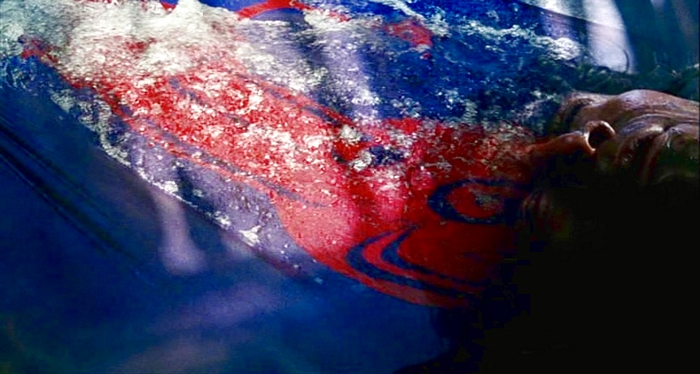
Four fleetingly experienced frames from Te Kai Po’s vision, part shared by Sarah; their meaning only clarified late in the narrative. The initially mysterious object trailed in the water, its red about to turn to a deluge of blood, is later revealed as one of Te Kai Po’s battle flags.
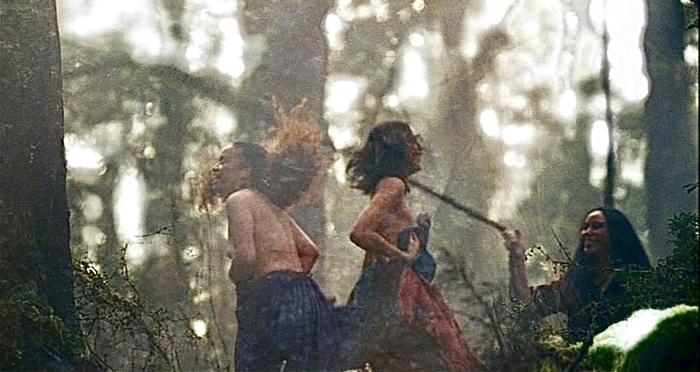
Girls skipping, later revealed as one of of Te Kai Po’s decoys, distracting the advancing soldiers
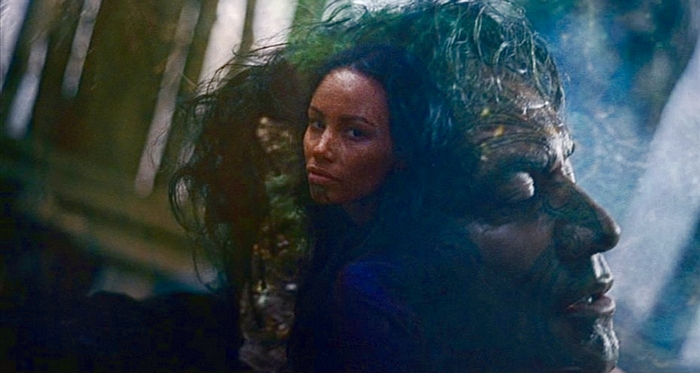
The young woman with whom the chief dreams intercourse, later actualised in his extraordinary plan to avert war through an adulterous liaison that results in his allies withdrawing their support

Te Kai Po about to hongi with a venerable visitor, the husband of the woman with whom, we learn later, he has an adulterous liaison
These fleeting oneiric images mostly resist immediate comprehension, their literal decoding retarded till considerably later – the women skipping revealed as one of Te Kai Po’s battlefield decoys, the whiteheaded older man as an allied chief, the younger woman his wife, her look the prelude to Te Kai Po’s adultery, precipitating his allies’ withdrawal and the abandonment of Tauranga-ika and the war. These last underlie the film’s boldest fantasia on revisionist history, combining Belich’s insistence that Titokowaru’s political life oscillated between war and early and late commitment to peace, and an acceptance of Cowan’s anecdote of the adultery causing the pa’s abandonment.
When Te Kai Po speaks of challenging death through woman, viewers may initially interpret this sexually, as some kind of Maori tantricism, or, more conventionally, immortality through progeny. The later narrative, however, has him deliberately fulfilling his dream of intercourse with the chief’s wife in order to make continued war impossible because of the split alliances his sexual act will cause. This mind-stretching trope continues to a degree the obscurity Ward often cultivates (for instance, the unexplained cut from Arvik wandering the hell of saturation-bombed hell of Dresden to Arvik in the Arctic twenty years later in Map). Here it is clarified by fairly overt dialogue and monologues pinning his act’s meaning down (if not its obscure visionary growth) with such elements as Sarah’s wondering voice-over, “Did his desire for the comfort of women get the better of him? Or did his dream warn him that he must provoke his people into retreat, and that way avoid a river of blood?” And the last exchange between Te Kai Po and Wiremu — (Wiremu) “We could have won this day”. (Te Kai Po) “The battle, yes. But winning the war? Never!”. (Wiremu) “What now?” (Te Kai Po) “Let the people go … We adapt or we die”.
Besides being thematically central, these oneiric images, and others prefiguring and recapitulating them (especially at the film’s opening, again during Te Kai Po’s water cure, when in mid battle he is strangely seen having sex, and when the wounded Sarah, Boy and Wiremu escape by water) are best explained in part as Te Kai Po’s (or even at times Sarah’s) vision or cogitation, or even as the film author’s signature interpolation. The more obscure of them can be read in formal terms as moments where an art film discourse exists alongside the discourse of the epic action film, complicating it, infiltrating ambiguity, obscurity, ambivalence, difficulty and mystery, qualities which leak over into the narrative events. Gestures at two complex instances will have to serve here, the first verbal, the second wholly visual. Only an expert in Maori battle practices could say whether Wiremu’s and Hone’s trading war threats in an extraordinary language of overt sexuality is based on reality or is Ward’s and Toa Fraser’s invention (Maori subtitled as “Does your vagina have enough bite to satisfy my lust?”/ “If you are that horny, here is an outlet for your lust”, “Indeed Baine has a mighty penis” — this exchange between Wiremu and his younger cousin, another instance of family ruptures). This confrontation’s psycho-sexual yoking of the hyper-aggressive and the erotic, Eros and Thanatos, interacts, in ways too diffuse and intricate to more than edge into view here, with the narrative’s movement from war to provisional peace and future healing bound up with Te Kai Po’s sexual act.
More closely allied to Ward’s characteristic visuality are the film’s recurrent multivalent signifiers of writings and tattoos, with tattoos a kind of tribal historical writing, a skin-borne hieroglyph of kin and place joined allusively to other kinds of writing like the more individualistic proto-modern form of Sarah’s journal and Te Kai Po’s letter, the writings and rewritings of history the film gestures to – not simple deletion and replacement, but a palimpsesting as in Belich’s recovery of Cowan, and the meeting of all of them in the complex ideograph of the contemporary cinema image. These linkages – tattoo, tribal history, western historical writing, the individual’s diary, cinematic “writing” are allusively invoked in various parts of the film, as when, say, Sarah sleeps with the newborn Boy while a lace canopy casts down wholly peaceful tattoo like patterns of embroidered flowers on the pair, and more centrally in the opening and closing images of her scattered journal pages sinking in the water, the ink they are written in dissolving, blotching and spreading, the running inks suggesting the dyes of the tattoos, to which, it is suggested, at various levels they relate.
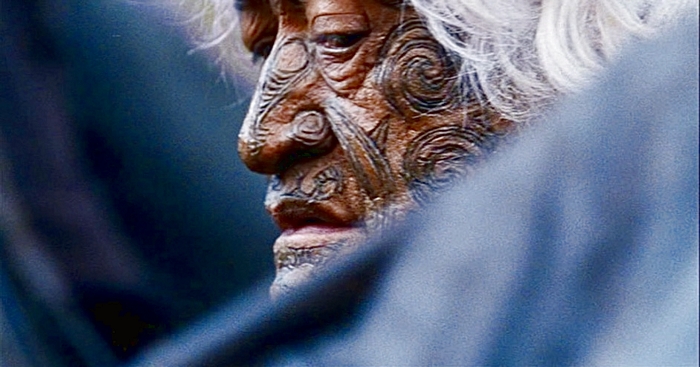
The heavily tattooed face of Old Rangi (played by Wi Kuki Ka who earlier played Wiremu in Utu). Beyond his role in the plot kidnapping Sarah’s son, Boy, as reprisal for her father breaking a tapu, the charismatic actor’s tribal facial moko introduces early in the narrative a thematic touching many forms of writing from tattooing to diaries and letters, to filming.
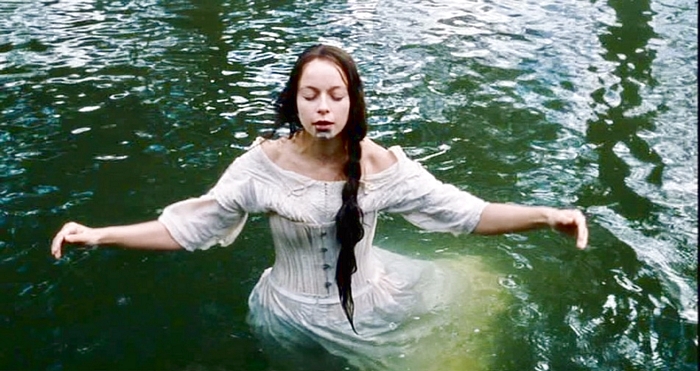
As demonstrated in the text of this article Sarah’s chin moko is part of a complex facial moko / facial moko-less design running through the narrative.
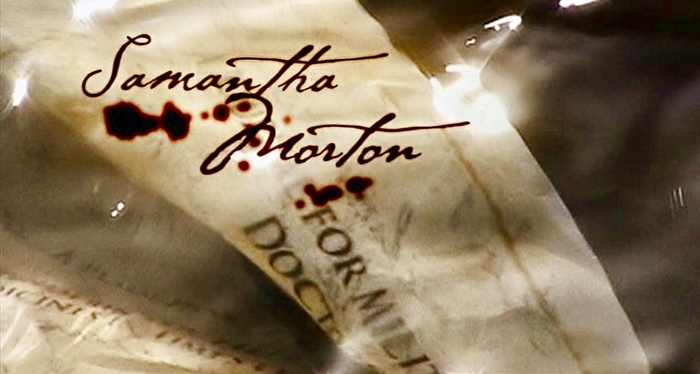
One instance from the final credits of the motif of writing, the ink dyes of Sarah’s diary writings and other documents dissolving in the sea like tattoo inks
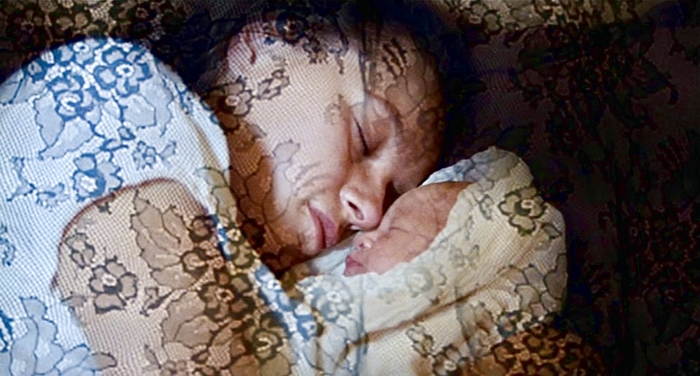
Sarah sleeps with the newborn Boy while a lace canopy casts down tattoolike patterns on them
NOTES
1. Judith Binney, Redemption Song: A Life of Te Kooti Arikirangi Te Turuku, Honolulu: University of Hawaii Press, 1997.
2. James Belich, The New Zealand Wars and the Victorian Interpretation of Racial Conflict, Penguin (NZ), 1988; James Belich, ‘Titokowaru Riwha’, Dictionary of New Zealand Biography (updated 7 April, 2006) http://www.dnzb.govt.nz/
3. See Trevor Bentley, Captured by Maori – White Female Captives, Sex and Racism on the New Zealand Frontier, Penguin (NZ), 2004; also Charlotte MacDonald, ‘Evans, Ann’, Dictionary of New Zealand Biography (updated 7 April,2006), http://www.dnzb.govt.nz/
4. James Cowan, The New Zealand Wars, vol.2; The Hau Hau Wars (1864-72); History of the Maori Campaigns and the Pioneering Period, 182 (referred to by Belich, The New Zealand Wars, 272-3, and The Adventures of Kimble Bent, 256-8, both New Zealand Electronic Text Centre http://nzetc.org/tm/scholarly/tei-corpusnewzealandwars.html
5. Belich, ‘Titokawaru, Riwha’, op.cit.
6. Robert Lang, American Film Melodrama: Griffith, Vidor, Minnelli, Princeton, New Jersey, Princeton University Press, 1989.
7. On McDonnell, see Belich, ‘McDonnell, Thomas’, DNZB (updated 7 April,2006).
8. Jane Campion and Kate Pullinger, The Piano: A Novel, New York, Hyperion, 1994.
9. Vincent Ward, with Alison Carter, Geoff Chapple, and Louis Nowra, The Edge of the World: Stories and Images from the Antipodes, Heinemann Reed (NZ), 1990.
10. Earlier workings of Celtic – Maori mythologies (though as much Highland Scottish as Irish) in late nineteenth and early twentieth century instances are discussed in Jane Stafford’s and Mark Williams’ Maoriland: New Zealand Literature 1872-1914, Wellington, Victoria University Press, 2006.
11. James Belich, Making Peoples: A History of the New Zealanders from Polynesian Settlement to the End of the Nineteenth Century, Honolulu: University of Hawaii Press, 1998, p.243.
—
First printed in Illusions; A New Zealand Magazine of Film, Theatre and Television Criticism, vol. 39, 2007, here with minor corrections and numerous added illustrations.