

A Short But Important Note On John M Stahl Holdings In Two Major Archives
A Short But Important Note On John M Stahl Holdings In Two Major Archives
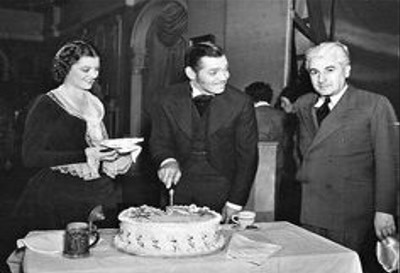
Myrna Loy, Clark Gable and Stahl celebrating, during the making of ‘Parnell’, what was almost certainly Stahl’s birthday (21st January) during the film’s shooting in January 1937.
The unexplained disappearance of what must have been the director’s large personal collection of papers and memorabilia was something that Charles Barr and I lamented in the book we edited together, The Call of the Heart: John M Stahl and Hollywood Melodrama (John Libbey Publications, 2018). The gap this left was a factor, we argued, in holding back appreciation of Stahl’s work compared with his peers’. Stahl died in 1950 and his third wife Roxana McGowan-Stahl remarried soon after. The missing personal collection was still only a phantom when we edited the book, though the Pordenone Giornato del Cinema Muto of 2018 for which the book was written and compiled, demonstrated through its Stahl showings that a great deal more of Stahl’s silent oeuvre survived than had been thought and thus was a landmark in the recovery of Stahl as an important director, with, to date, only the extant archive copies of One Clear Call (1922) and Why Men Leave Home (1924) awaiting a long-delayed Stahl III Pordenone showing alongside examples of his work producing, as distinct from directing, at Tiffany-Stahl (1927-29).
However, only this year (2023) did we find online reference to the ‘John Stahl Papers, 1922 -1955’, Collection No. 2234, in the Cinematic Arts Library, University of Southern California, noted as the ‘Gift of Roxana Stahl-Smith, May 25, 1965’. According to a recent email from the library other Stahl material, which Ned Comstock helped us with in researching the Pordenone book exists in a different collection in the Cinematic Arts Library’s Special Collections. Thus the mystery of what became of Stahl’s papers is at last clarified, and Roxana exculpated from suspicions that she might simply have abandoned her husband’s legacy, though, as will be seen below, clarified in a way that, disappointingly, cools some of the immediate excitement of the long-delayed discovery.
The collection’s 1922 start date makes it probable that it contains no or little information about Stahl’s early pre-Hollywood film making, starting as it does after Stahl’s move to Hollywood into partnership with Mayer and First National. 1922 is the date of release of the third, fourth and fifth of those films, The Song of Life, One Clear Call and The Dangerous Age. The collection’s 1955 end date is a minor puzzle, since it post-dates Stahl’s death by five years, but there are possible explanations for this – e.g. documentation added by others than the late director, connected with his death, obituaries, tributes, material concerning Stahl’s step children from his marriage to Roxana, etc? This is speculation until the boxes are properly processed and able to be researched (as regards which, see the bad news below).
Details given online are that the collection, amounting to 6979 linear feet, is housed in 6 boxes, and comprises ‘approximately 20 screenplays [whether annotated by Stahl or not is yet to be ascertained], correspondence, telegrams and memos; synopses and treatments; approximately 50 photographs and stills. Also included are sketchbooks for “Immortal Sergeant” (1943) and “The Keys of the Kingdom” (1944), and a research book for “Parnell” (1937) and a still book from “Leave Her to Heaven”’. Eight of the ‘approximately 20’ screenplay titles are given – “The Lady Surrenders” (1930), “Strictly Dishonorable” (1931), “Back Street” (1932), ”Imitation of Life” (1934), “Magnificent Obsession” (1935), “Parnell” (1937), “The Foxes of Harrow” (1947) and “Father Was A Fullback” (1949). As can be seen from the approximate nature of such information, ‘This collection is unprocessed’, and, as the Library informed us, ‘unpaged’. Indeed it is not held now in the Cinematic Arts Library but in storage, which more than suggests that processing is not being urgently pursued after 59 years, even when there is evidence in festival showings, dvd releases and writings of a renewed interest in Stahl and his output, both silent and sound.
When we researched the book we were in touch with Ned Comstock at the Cinematic Arts Library, a revered figure among film researchers for his knowledge and his role in building the great USC film collections. He helped us with material from the library’s other Stahl holdings (circa 2017), but seems to have known nothing of the Stahl-Smith bequest, which is extremely curious, though he was from 2015 very seriously ill. The Library has informed us that information about the Stahl-Smith gift was not put online until circa 2014 (49 years after the bequest, my addition), which part-explains why neither we nor the American film scholars who contributed to the book were aware of this important resource. Only part-explains because the greater amount of research for the book took place circa 2016, which makes it appear that any online appearance must have been later than 2014 to be missed by numerous scholars — some of them American — assiduously searching for information about Stahl.
Whatever the situation then, it is happily certain now that Stahl’s personal archive survived. But our initial excitement, no doubt now shared by others who have contributed to the recovery and reassessment of Stahl, is depressingly tempered by the fact that its undoubtedly valuable contents are not yet available for research, and, judging by the lack of urgency transmitted to us, unlikely to be so for a considerable time (though, it is to be hoped, not another 59 years!). As to this, might we suggest that those interested in Stahl urge the Library to make the gift’s contents easily available to researchers by proceeding as quickly as possible with the ordering of the boxes’ contents. The Cinematic Arts Library is at present understaffed, a result of the Covid crisis, but the neglect of the Stahl papers is longstanding, dating from 1965. The only way I can see the necessary work to turn it into a research resource happening is through a concerted effort by scholars to make the Library repair its failure to honour the bequest.
A French Connection
A smaller but important collection of Stahl material is held in the Bibliotheque Nationale Francaise in Paris. This writer is unaware of how it came to Paris (might Roxana have separated its contents from the main body given to USC to gift or trade it?), but that may be discoverable in time. The holding consists of a significant amount of correspondence between Stahl and actors, writers, scenarists and film composers. In the first category – Claudette Colbert, Jeanne Crain, Henry Fonda, Thomas Mitchell, Maureen O’Hara, Gregory Peck, Vincent Price, Gene Tierney, Cornel Wilde, and Warren William. In the category of writers and scenarists – William Hurlbut, Nunnally Johnson, Joseph Mankiewicz, Joseph Swerling, Lamar Trotti, A.J.Cronin, John Brophy, Fannie Hurst, and Ben Ames Williams. In the category of composers of film music – David Buttolph, Alfred Newman, and Heinz Roemheld. Additionally, there is listed correspondence with 20th Century Fox, PFC Video and Fox Video.