

Local Hero: Whatever It Takes: Pacific Films and John O’Shea 1948-2000 by John Reid
Local Hero: Whatever It Takes: Pacific Films and John O’Shea 1948-2000 by John Reid (Victoria University Press, 2018).
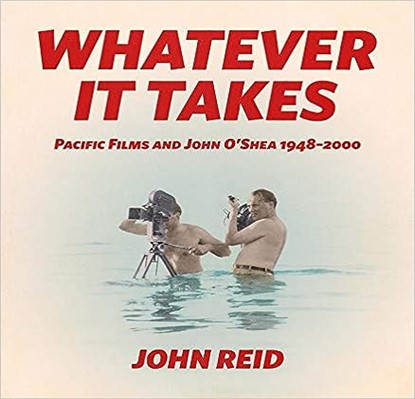
Many years ago I was invited by the New Zealand Film Archive to try to order the mass of material in its John O’Shea / Pacific Films collection. The plan fell through, but I often wondered whether the project would be resurrected. That question has now been unequivocally answered by John Reid’s monumental book which follows the company’s more than fifty year history in expansive detail. Originating with Roger Mirams and Alun Falconer in 1948, it significantly metamorphosed in 1950 into Mirams’ new partnership with John O’Shea (a history graduate and cinema aficionado, without film making experience). At O’Shea’s insistence Mirams’ idea of an interracial marriage documentary was ambitiously reworked into Broken Barrier (1952), the first New Zealand fiction feature since 1940. After Mirams left in 1957, O’Shea ran the company, attracting many talented associates, as by far the country’s foremost independent producer, until his death in 2000.
His papers record some 320 productions (not counting commercials, the company’s main source of income): documentaries, newsreels, magazine series, sports coverage, road safety instructionals, political broadcasts, trade and promotional films, travelogues, etc, for a multitude of clients, e.g New Zealand Railways, the NZBC, the various Marketing Boards, Caltex Oil, Crown Lynn Potteries, etc, and nine feature films, generating a deluge of correspondence, records, reports, submissions, interviews, wage books, articles, radio talks, diaries, all these and more the material of Reid’s history. In addition, there are many precious photographs of the films being shot, a large number of them rarely, if ever, published before. To mention a single instance of many in the book, one, taken during the shooting of Tangata Whenua, of Piri Poutapu speaking with Michael King at the Turangawaewae Marae, Ngaruawahia, perfectly illustrates Barclay’s method of shooting interview material with non-urban Maori at an unintrusive distance with a zoom lens.
John Reid, a fine feature film director (Middle Age Spread, Carry Me Back, The Last Tattoo) with significant documentary and tv experience, worked for periods in the Pacific “family”, and his last feature Leave All Fair – based on Katherine Mansfield relationship with John Middleton Murry – was produced by O’Shea in circumstances giving Reid intimate working knowledge of O’Shea as hands on producer. Involved in national film politics, he wrote a 1972 report influential in establishing the Film Commission. Crucially he also has a talent for clear exposition not only of the mechanics of every stage of film making, but of the personalities, the always debilitating economic pressures, and local debates of those times – one exemplary instance being his account of O’Shea’s inescapable relationship with the exhibition / distribution empires of Robert Kerridge and the Moodabe Brothers who with their overseas shareholders saw no need for more than rudimentary local production, though occasionally capable of largesse. A nice anecdote dramatises how independents were caught between the two: Mirams, filming in Willis Street a short for Amalgamated’s theatres, unwittingly included in a shot a tram carrying a poster for a Kerridge film, which resulted in the Moodabes boycotting Pacific Films, a disastrous prospect only resolved by O’Shea’s appeal to Prime Minister Holland, which illustrates his willingness to buttonhole politicians in defence of independent film making. John Marshall, the National cabinet minister who sent an encouraging note after the Broken Barrier premiere, was also persuaded to make interventions as O’Shea fought against the unbroken anti-independent barriers erected by newly instituted television and the National Film Unit.
Much of Pacific’s work was undertaken not just to keep afloat but to help finance ambitious documentaries and feature films addressing New Zealand’s specificity. Reid does not neglect this necessary quotidian activity, though naturally he emphasises films valued by critical concensus, for their (bi) cultural importance – Tangata Whenua, The Spirit and the Times Will Teach, and for their sometimes experimental subversion of mainstream documentary – Tony Williams’ The Sound of Seeing, Take Three Passions, The Day We Landed on The Most Wonderful Planet in the Universe, and Barry Barclay’s, The Town That Lost a Miracle, Autumn Fires,The Neglected Miracle). But he finds space for the perenially charming Edmonds promotional Cookery Nook, as well as the Caltex pre- television rugby coverage ( I remember at an allnighter before the 4th test in 1956 at the Tivoli in Karangahape Road, watching Cliff Morgan evading flankers van Wyk and Fry in the 1955 British Isles v Springboks tests, a small scale example of Pacific’s international outreach, more obviously evident in documentaries like The Neglected Miracle and Women in Power: Indira Gandhi, as well as the international aspects of Leave All Fair). One caveat: the mass of material sifted is so great that interesting works are sometimes mentioned so fleetingly that this reader was frustrated, e.g. the series Hunting Horns on that fascinating figure James Bertram and the home insulation promotional All That We Need which O’Shea surprisingly called “one of the more imaginative, almost poetical films I ever produced” (Seriously? teasingly?). Given their absence from the ‘NZ On Screen’ site, one wants to be told more.
The nine features are all well covered, with numerous revelations of interest; e.g, that Broken Barrier’s “narratage” of overvoices replacing dialogue, had a source in George Montgomery’s Lady in The Lake; the reasons for the plot lacunae in the Isobel (Kiri Te Kanawa ) sections of Runaway, and for Leave All Fair’s late switch of directors; the question (unanswered) of how Mirams’ original plan for his “pretty hot stuff”of a “Maori bloke marrying a white girl” changed to a less code-breaking relationship? (probably simple pragmatism). It’s especially interesting that Ngati’s making, so important in the history of Maori and film, was much less serene than perhaps we’d like to believe, with Barclay’s tensions with Tama Poata and O’Shea foreshadowing troubles that undermined the later Barclay/O’Shea partnership on Te Rua.
O’Shea after Don’t Let It Get You (1965) found producer-directing too much and adopted the creative producer’s role for the rest of his career, producing Te Rua with Barclay directing. It should have been the culmination of O’Shea’s pursuit of his central bicultural subject. Adapting to change, he saw Broken Barrier as “warmed by the dying embers of noble savage sentiment”, whereas he hoped that Te Rua would draw together the subject’s most contemporary inflections: the return of taonga; “glocalism” in its ambitious geographical stretchings (Berlin,Wellington, rural New Zealand, third world characters); national and international audiences through its Berlin / New Zealand co-production; reconciling maoritanga and O’Shea’s pakehatanga, as well as the “uneasy amalgam” between commerce and art. Reid sheds light on its conflicted making and eventual foundering through Barclay’s alcoholism and inability to deploy the thriller format he had initially devised to present complex material to a wider audience, finally missing most of even the Maori part of the home one. As Reid writes in conscious understatement, “The central issue of the film – maori control over their taonga – readily became Barclay’s raison d’être for rejecting input from others. For an international co-production between at least four partners in two countries, this was a difficult position to sustain.” “O’Shea felt that while he had an underlying regard for Bazza [Barclay], his incapacities as a director were visible for all to see”. In the end “significant sections of the script remained unshot…”, leading to the film’s virtual eclipse. Nevertheless,for all its flaws it remains for this writer a film of at least extraordinary parts.
The O’Shea of Reid’s history is both solid and charismatic; driven and reasonable; simultaneously natively inward looking and outside world cultivating; intensely idealistic yet groundedly pragmatic – asked if he would ever work with Barclay again after Ngati’s traumas he replied “A short memory is desirable in film”, and despite Maurice Shadbolt’s aggressively destructive Bulletin review of Runaway, he collaborated with him on Among the Cinders. He, of course, had his blind spots; he minimized his and New Zealand cinema’s debt to Rudall Hayward, a case of oedipal “anxiety of influence”, and he perhaps was feeling a bit left behind when he wrote unperceptively that neither “Tony’s [Williams] Solo or Roger’s [Donaldson] Sleeping Dogs are going to have much relevance to New Zealand or make any sort of impact”. But it’s hard not to love a man who eulogized the screenplay of Hiroshima Mon Amour and repeatedly watched L’Avventura on Runaway’s rough Westland location, and whose highest accolade was “shit hot!”
You might think that Reid’s hugely detailed catalogue of dates, costs, derailed projects, draining debts and risky recoveries might make for prosaic reading, but it doesn’t. His pages cumulatively assert what the last explicitly insists, that O’Shea’s and Pacific’s were in their way heroic lives.
First printed in The New Zealand Review of Books with title ‘Reeling in the Years’. Reprinted here with a few minor alterations.