

Postcolonial Poppyshows: some extramural afterthoughts on the improprieties of ‘Seven Periods with Mr Gormesby’, Series One
Postcolonial Poppyshows: some extramural afterthoughts on the improprieties of ‘Seven Periods with Mr Gormesby’, Series One
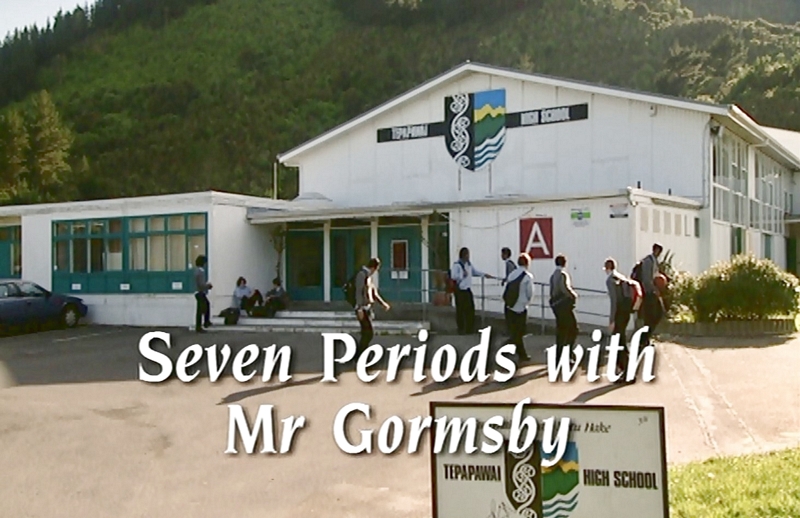
Some negative reactions to the first series of Seven Periods with Mr Gormsby (TV1 2005) underline the ‘inconstancy and contingency of the comic effect’ (1). One complaint to the Broadcasting Standards Authority argued that the anti-hero supply teacher’s pretence of being about to “bum” one of his pupils, in order to elicit another’s confession of authorship of a drawing entitled “ Gormsby Takes it Up the Arse” inappropriately derived comedy from paedophilia. Another (also rejected) accused a further episode of “degrading” treatment of teachers and students ad of having “ridiculed Maori women” An unofficial complaint found the portrayal of a retarded boy unacceptable (2). Freud – quoted above from Jokes and Their Relation to the Unconscious – also noted that ‘the generation of affect is the most intense of all the conditions that interfere with the comic”, and “affect” clearly dominated these viewers’ responses, though it is clear that for many the pleasures of ‘humour’, defined as comedy depending on ‘an economy of pity, anger, pain, tenderness, and so on’ predominated.
Some contemporary British and American sitcoms have radically distanced themselves from secure classical prototypes and 1970-1980s ‘warmedy’ in the direction of burlesque, parody, ambiguity, degradation and Freud’s ‘humour’- influences apparent in Seven Periods. Such comedy, elasticising the acceptable, is programmatically divisive. 1950s-60s sitcom, broadcasting to huge unsectored audiences, could not afford offence, but some recent, more narrowcast comedy requires some negative reaction as proof of its cutting edge, hence the unintentional validation provided by the complaints above.
This analysis is restricted to Seven Periods’ first series, judging that the second and last series (briefly discussed at the end of this essay) – following the first’s late movement to ‘warmedy’ in Gormsby’s reference for Hohepa, 5 F’s haka of tribute, and their teacher’s gruff compliment that the mostly Polynesian class are “proud stock” – though still finely written and performed, exhibits less fractious, less culturally interesting comedy.
Seven Periods’ underlying situation is that Tepapawai Boys High, as near to decile zero as possible, constantly facing closure, is forced in its search for a supply teacher for its worst class 5F to reemploy Mr Gormsby (David McPhail), whose reputation precedes him.
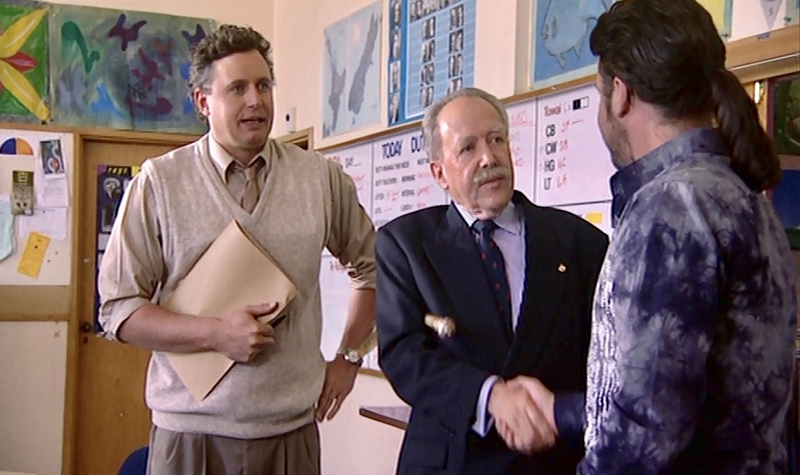
Precariously stable Headmaster Roger Dasent (Paul McLaughlin) introduces Gormsby (David Mc Phail) to his opposite, Steve Mudgeway (Jason Hoyte).
Mr Morton: “Come on, Gormsby’s not that bad.”
Ms Tangaroa: “He is. Remember the last time he was here. He used the cane.”
Mr Morton: “Yeah, but it was legal back then.”
Ms Tangaroa: “On a student teacher?”
Ms Partington: “She almost miscarried.”
This interchange’s coda, increasing rather than mitigating Gormsby’s outrageousness, sets the tone for the whole series. Episodes involve such abysmal incidents as Elvis Hohepa’s (R.J.Smiler) obscene drawings on the schoolroom blackboard, the union attempting to sack the politically incorrect Gormsby, the school’s attempt to generate grants by admitting handicapped boys, the mistaken supposition that Mr Morton (Alastair Morton),the homosexual teacher, has AIDS, a rumour mostly stemming from Gormsby), a profoundly misfiring bicultural arts performance, the finding of Afioga’s (Feterika Sage) discarded condom after the 15 year old has sex with Ms Partington (Tandi Wright), Ms O’Flaherty (Dena Kennedy), another teacher’s, abortion, the Headmaster’s removal to a mental hospital, and so on, this summary only skirting politely around the unruly provocations contained in the various episodes.
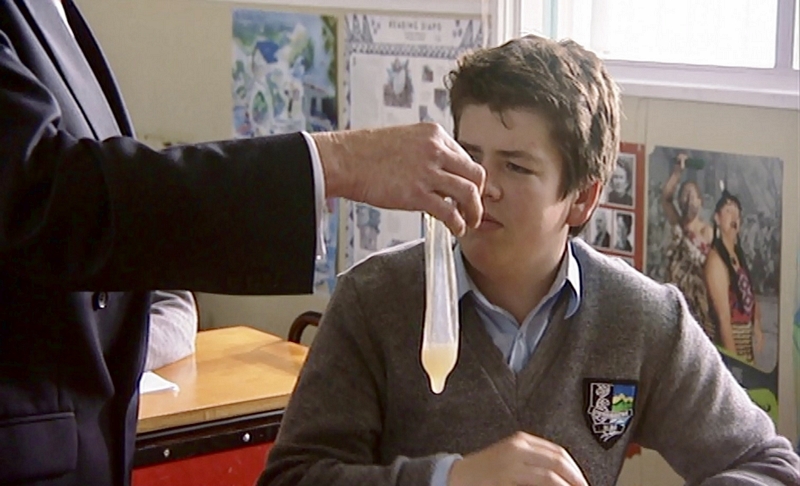
Abysmal incidents: Gormsby displaying Afioga’s discarded condom. Bastabus (Joseph Moore) in frame is not the culprit.
Like all sitcoms Seven Periods with Mr Gormsby interweaves repetition and variation, here the generative clash of Gormsby’s oldfashioned anti-liberal views on race, discipline and sex and contemporary cultural changes with the school’s (often shallowly and opportunistically held) early 21st century ‘paradigm shift’ ethos, constantly repeated but varied in its manifestations. Gormsby’s catalogues of comic invective- “You won’t find me running off to the PPT-bloody- A, going on strikes, holding balloons, singing nursery rhymes, so I can get a pay rise, extra holidays, tangi leave, and a warm flannel to wipe my boyfriend’s bottom with” and “well you won’t get any of your namby pamby Witi Ihimaera lesbian awareness week Maori mumbo jumbo magic realism with Gormsby” – are pervasive instances of this. They are expected and therefore familiar, but wittily varied and therefore surprising, as when he takes Miss O’Flaherty’s ‘Human Relationships’ lesson during her abortion, turning it into a ‘Human Relationships’ spelling test: “bastard – Steve is a bastard”, “buggery – this school has gone to buggery”, or in the staff-student cricket match inflects the convention of the umpire informing batsmen of the bowler’s type into “left arm lezzie around the wicket”, “limpwristed homosexual, one to come”, “left wing liberal highly pissed off, one to come”.
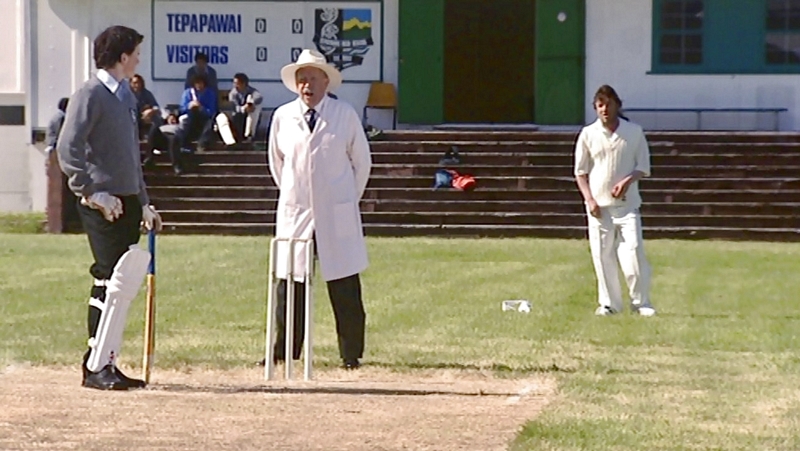
Gormsby umpiring, “Left wing Liberal highly pissed off, one to come.”
The unregenerately named episode ‘Coon Tunes’, as usual, presents the school as an abject new order microcosm- its pupils low achieving Islanders, Maori, a few Pakeha, an Indian and a Vietnamese; its staff a lesbian, a male homosexual, a Te Reo challenged Head of the Maori Department, and so on. It exhibits a caricatured version of post-millenium New Zealand with its insistent but often shallow emphasis on bicultural, multicultural and sexual political correctness. It would be an unaware local viewer who failed to connect its name with the capital’s celebrated new order museum, Te Papa (“Our Place”), with the school the degraded (or more realistic) underside of the idealised bicultural, multicultural mythic post-millennium storehouse. (For a Gormsby-like extra-televisual frisson, try playing Te Papa’s early pioneer immigrant game [as of 2008], and, if given a female identity, when personal alliances are broached, press “Same Sex” and see what congratulations and good fortune come up).
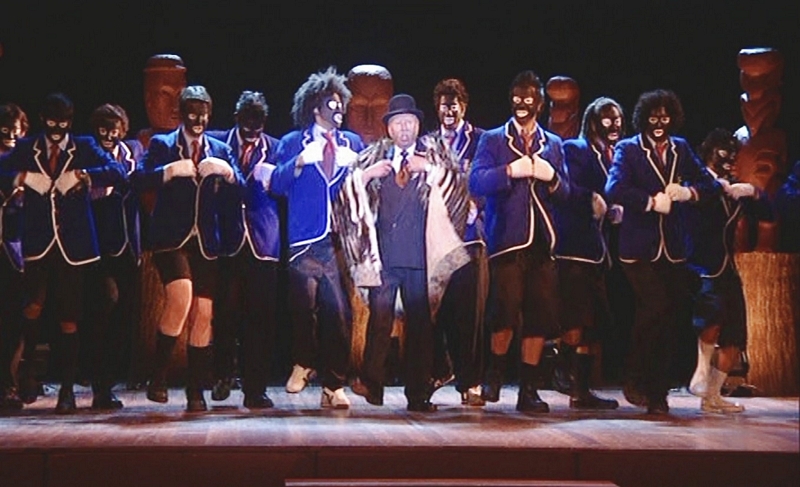
“Coon Tunes” centres on the school’s cultural performance evening, irresistibly reminiscing Paikea’s memorably affecting school stage appearance in Whale Rider, a film whose calculated charm derives from the hyper-idealisation of its Maori, and the all but absolute disappearance of Pakeha from it, cultural tendencies vigorously subverted by Gormsby, when, after scornfully tossing aside curriculum mainstays Patricia Grace’s Potiki, Keri Hulme’s The Bone People and Witi Ihimaera’s The Whale Rider, to 5F’s delighted horror, he sets fire to the latter. The satire derives less from mocking literary underdogs – which none of the three authors and works remotely are – than from scepticism towards works which have been made unarguable icons by cultural-political expediencies. (On the shortlived international overvaluation of The Bone People, the precondition of its local valorisation, see James English’s The Economy of Prestige’s outline of the book’s curious route into the realm of the locally uncriticisable) (3). Gormsby’s cultural vandalism, produces for this viewer, and, I am sure for many – though by no means all others – that ‘cynical (critical, blasphemous) laughter’ which is Freud’s third category of the tendentious – aimed at the canons of the contemporary secular-sacred, at the institutionalisations of cultural propriety. In other words the scorn is not so much aimed at the well known authors and texts as their unquestioned status within the prescriptive dictates of official culture. Rather than attacking an externalised other, the comedy invokes something closer to home, the communal self, or part of the communal self’s resentment at controlling belief systems, unburdening the tensions of the participant -believer as with the Jewish joke told by the Jew, the Catholic joke told by the Catholic.
Returning briefly to the second BSA complaint about the ridicule of Maori women; although the complainant confused the excessive particular with the normative general, he also somewhat understated the particular case. Lesley Tangaroa (Grace Hoet), the PE teacher, is a huge short-tempered Maori lesbian, given to loud uninhibited farting, an inept teacher like the other staff, who, in a mischievous reversal of domestic violence stereotypes, bashes Agnes O’Flaherty when she rejects her sexual advances. The comedy developed around her degrades semi-official cultural tendencies to idealisation of the categories ‘female’, ‘Maori’ and ‘Lesbian’ – representatively excessive filmic and televisual examples of which can be found in Deborah Shepard’s compendious history of New Zealand women film makers. (4)
Such comic degradation would be merely hostile outside the context of these highly influential cultural validations and their accompanying decentring critique of masculinity and heterosexuality in hosts of books, articles, and journalism. They fuel the heavy but unsimple mockery of Gormsby’s reiterated “Mr Morton takes it up the arse, but there’s nothing wrong with that” and his reassertion of now unfashionable masculine literary tradition against the liberal curriculum’s elevation of female and homosexual writing when he slams Melville’s novel down on the desk, saying with reference to The Whale Rider, “You want a story about a whale? [slamming a book down on the desk] Moby Dick”. Even so, Seven Periods is satire impure enough to allow almost all its satirised characters attractive traits, with Morton, the gay teacher pleasant and wholly without malice, and Lesley Tangaroa generating unexpected moments of sympathy as she apologises to Agnes, unexpectedly smiles at Gormsby’s joke about The Piano, and punches Steve after his crude lesbian joke.
Bergson in Laughter writes of professions and societies imposing the Mechanical upon the Organic – the core of his comic theory – especially citing the language with which the lawyers, doctors, and pedants of French comic drama distort reality. ( 5 ) Seven Periods extracts comedy from various analogues of these – the right on indicators in the teachers’ union meeting; Steve’s acquisition of managerial mumbo jumbo like “upsize” and “core business”; Fenn Partington’s balletic psychomachia of Pakeha angst with ‘Inner Self’ circled by ‘Self Alienation’ and ‘Peer Pressure’, until rescued by ‘Community’. But, interpreting Bergson widely in terms of the language of the bicultural, multicultural and alternative sexual ideologies prominent in official national life, the prime instance is the vocabulary of biculturalism, creolistically burlesqued in the substitution of Maori words for English in Gormsby’s Stephen Foster “coon waiata”. Extensions of this linguistic comedy find the sacred-secular terminology becoming cliché, phatic noise, the path to promotion, a mere token of cultural-political propriety, especially for Steve Mudgeway, the professionally Polynecised Pakeha, growingly revealed as the series’ villain.
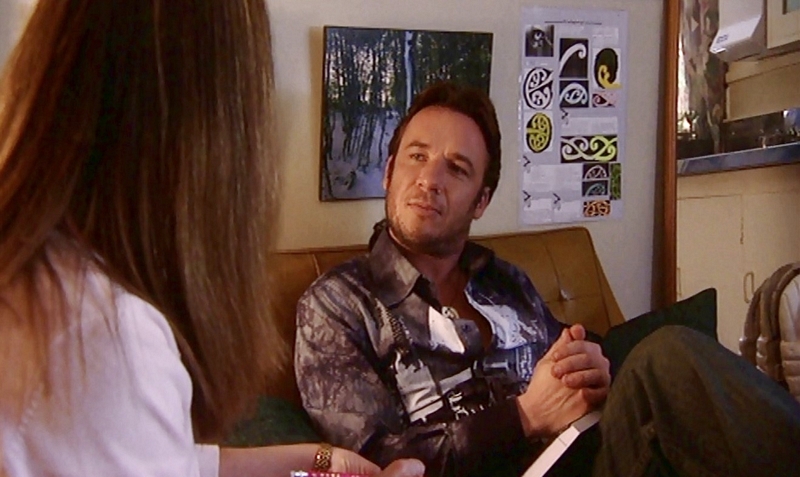
Steve Mudgeway turning on bicultural charm for Agnes.
Examples proliferate: Steve seducing Agnes with his “spirituality”, “You know, in the Maori realm they’d say ‘Ahua’”; Mr Hakanui (Louis Sutherland), the Head of Maori, who, interviewed by a Maori speaker, embarrassingly turns out to lack Maori language beyond the few terms ‘mihi mihi’, ‘mahi’ and ‘kaupapa’, etc., with which he sprinkles his speech. Indeed when Afioga’s condom is found in the wharenui and Hakanui asserts “we demand a whakarewarewa in the wharenui”, he is corrected by Tangaroa, “Get it right! It’s a whakawatea. Whakarewarewa is a place!” The Pakeha Steve is the individual most associated with such usages, for instance where he makes Hohepa read the terms of his “tiriti” with the school, a document presumably written by Steve himself – “I promise to respect the cultural values of all teachers in the Te Papawai iwi khanga”.
The abject cultural evening’s entertainment originally proposes to us the Polynesian boys’ hip-hop and rap as a contemporary item. Gormsby, however, teaches them what he calls a Stephen Foster “coon Tune”. Intercepted In rehearsal, it is reworked, apparently more acceptably in front of Marion Patterson (Geraldine Brophy), the ERO chief. However, as finally performed, instead of the gravely winsome Keshia Castle-Hughes bravely speaking through her tears in the celebrated film Whale Rider, there is the grotesquely reprehensible sight of Gormsby with painted moko, bowler hat and old fashioned suit covered with a traditional kakahu, surrounded by blacked up boys, mostly Polynesian, rolling eyes and waving whitegloved hands in minstrel show style as Gormsby sings Stephen Foster’s “Dere was an old darky an’ dey called him Uncle Ned”, inflected into “Dere was an old Maori and his name was Matua Ned”, substituting Maori for Darkey, Matua for Uncle, opoko for head, taiaha for hoe, whenua for ground.
As Jokes and Their Relation to the Unconscious also notes, jokes and comedy act automatically, the routes of their immediate workings only later available to analytic consciousness. Those audiences laughing, or not laughing, at “Matua Ned” react equally to the degrading of bicultural thematics. Whatever analysis retrospectively constructs is mediated through an antic thickness of allusion, taking in 19th century Maori appropriations of Pakeha culture and white appropriations of Afro-American culture with early 20th century entertainers like Al Jolson and Eddie Cantor, and the more recent now notorious Black and White Minstrel Show also alluded to, as well as the longstanding historical tradition of Pakeha self-definition through appropriation of Maori signs. “Matua Ned” is prefaced by other cross-cultural variations earlier in the episode, beginning with the Polynesian boys’ break dancing, which Gormsby supposedly perceives as an epileptic seizure, followed by the Pakeha boy, Bastabus, ludicrously imitating them, a Pakeha version of a Polynesian version of a white version of an Afro-American source (Gormsby appears to believe, or pretends to believe that Stephen Foster’s songs are indigenous black music). Whether these versions and perversions tendentiously mock Maori or Pakeha more is difficult to assert, but it might be argued, both equally. More certainly the comedy disapproves the ERO chief, Marion Patterson’s angry reaction to Gormsby’s show, on the grounds that it is another instance of the self- interested use of hegemonic ideologies particularly associated with Steve.
Seven Periods operates by opposing partly privileged to less privileged negatives in a way comparable to Ben Jonson’s great plays Volpone and The Alchemist, with their scourge figures tormenting innocents and rogues. The analogy is imperfect, but suggests how comedy can operate by opposing defective positions – Gormsby’s outdated prejudices versus the pipe dreams, virtue-signalling and hypocrisies attendant upon the hegemonic philosophies – although Seven Periods, allowing some sympathetic identification all round is less fierce than Jonson’s art, as dictated by sitcom’s more compromising ethos. Though Gormsby is a comic monster related to Alf Garnett, Archie Bunker, Gordon Brittas, Alan Partridge and Basil Fawlty, he is not so entirely defined by frustration and impotence. Awful as he may be, with his catalogue of contemporary crimes running from misogyny to racism (though there is a teasing playfulness about his utterances which gives them an air of experimentally testing for faultlines in complacencies), he commands a certain authority, generally knowing more than the other characters. For instance, though he must be the first New Zealander since Robert Louis Stevenson’s ‘The Beach at Falesa’ (1892) and Gaston Melies’ Tahitian films (1912) to use the term ‘kanaks’ for South Sea Islanders, he pronounces the Islander boys’ names accurately.
Significantly no episode concludes with him defeated. For instance, by following the example of Hohepa’s latrine cleaning uncle Dion, he frustrates the union, and his car park drilling of the boys saves Ms O’Flaherty’s life. This last raggingly complicates the liberal viewer’s disapproval of Gormsby’s militarism and equation of Polynesian employment with the armed forces, with suggestions that his understanding of adolescent boys is, for all is unadjusted defects, livelier than that of many of those professing more advanced views.
A further complexity for the local audience is Gormsby’s relation to the comic actor David McPhail’s most celebrated previous role, his impersonation of the famously abrasive former Prime Minister Robert Muldoon. Though spicker, more self-contained, more anglicised in manner, without gestural or vocal imitations, Gormsby references Muldoon in several ways. He is unerring in his instinct for opponents’ weaknesses and possessed of an aggressively disabling wit, as he shadows the figure James Belich views as the last of the ‘better Britons’ undertaking ‘recolonisation’s last stand’, fighting rearguard actions against a changing New Zealand, characterised by ‘a philosophic as well as pragmatic commitment to the way we were’ (6).
Part of Gormsby’s multifacetedness is that though he speaks in outmoded, calculatingly offensive ways, he offer reminders of values not in themselves, or in a more liberal, contemporary inflection, undesirable. Society, in all is various groupings, is aware, or should be aware that it has compromised those values – discipline, plain-dealing, and intolerance of cant and pretension, though all in a mode as satirically deformed as the contemporary mores of Gormsby’s foe, the embodiment and, simultaneously, subverter of left wing values, Steve Mudgeway.
Mudgeway is a shapechanger, literally so in the last episode when, achieving power, he dispenses with his talismanic ponytail and bone carving now that they have served their purpose. Keyed into the culturally desirable, Steve even teaches film-making, has a photo signed by Peter Jackson commemorating his role – significantly that of an Orc – in the extended DVD of the first Lord of the Rings film, and is as sporty as intellectual. The reality of his counselling of the errant Hohepa, though, is engineering his expulsion, whereas Gormsby writes him an idiosyncratic paternalistic reference asserting that he is “worth saving”. And if Gormsby with his confirmed oldfashioned bachelordom is a mixture of elaborately gallant condescension and images of reproductive distaste towards the women in the school, it is Steve who, with their benighted assistance, victimises the better looking of them.
Mirroring audiences’ expected complex, divided response, the series’ various internal audiences are presented ambivalently rather than unidirectionally in their reactions to Gormsby. The audience’s immediate reaction to “Matua Ned” is silence, then a standing ovation, ironised, however, by their misreading, aided by Gormsby’s intervention, of Marion Patterson’s angry rising (to leave) as a signal for general applause. Shots of watchers during the performance (though only Marion looks definitively disapproving) vary between registering amusement and puzzled, impassive, or otherwise ambiguous reactions.
Likewise Gormsby’s main audience, the boys of 5F, register opaque reactions to his wit on more occasions than laughter or approval, an ambivalence carried on by the various members of the staff, and Lauren, Headmaster Dasent’s secretary (Michele Amas), whose attitude to Gormsby seems more often disapproving than approving, but who, finally, when Steve suggests a celebratory drink, celebrating that is Gormsby’s departure, has already left the room, presumably to join the other staff following Gormsby down the drive. Dasent’s strained, growingly hysterical laughter can be seen as excessive paradigm of the divided laughter Seven Periods constantly provokes.
A happy byproduct of New Zealand’s notorious failure [as of 2008, the date of this article] to make home grown generic productions is that Seven Periods looks special, has escaped the conventional sitcom look which never became an NZTV industrial norm – the flat lateral field, the stock three camera movement between medium close shots and closeups, the live audience presence laughter track, with cinematic inventiveness restricted to montage opening sequences. While obeying sitcom’s largely immutable laws, Seven Periods is decided cinematic, with, for example, the melodramatic expressiveness of the low angle shot of Steve interrupting Gormsby about to whack Elvis Hohepa, “Touch that child and you’ll never teach in another New Zealand classroom again!”. Then there is the deep corridor long shot as Hohepa walks toward the camera, kicking the waste bin, after being thrown out of class – both of these examples from the first episode of a richness of image unusual for the genre. This cinematic influence continues in its rapid movement between multiple sites (episode 1 with 33 segments even outdoes Seinfeld, the paradigm of such mobility), and in its alternate syntagma sequences, i.e. segments alternating between different sites, almost unknown in situation comedy.
Seven Periods second series (2006) retreat from the first’s abrasive extremes is most plausibly interpreted as pressured less by political prurience and loss of nerve than by the near impossibility of sustaining the first series’ pitch of satire within sitcom parameters, a balancing act complex enough to invite Jonsonian analogies. In one episode, representatively responsive to more conventional sitcom’s siren song, a more prestigious school attempts to poach Hohepa’s rugby skills, revealing Dasent’s and Mudgeway’s susceptibilities to a $NZ60,000 bribe. Here and in the parallel plot’s play with the borderline material of internet chatrooms and underage porn, Gormsby’s role is softened and diminished, his familiar cultural and sexual barbs by now almost comfortably reassuring signs of acceptance of the polymorphous. His one bravura monologue, is a grimly comic vignette of an All Black’s decline from fame to past peak contract in Japan, unsuccessful commentating stint, and terminal arthritis.
Touching satiric pressure points ecumenically relevant to Pakeha, Maori and Islanders (the majority of the class) alike, though with slightly more force for the latter groups, given Hohepa’s restricted routes to upward mobility, the comedy is still finely tuned and socially observant, but certainly less edgily rebarbative. Gormsby, the friend of the boys only by oblique comparison with others, has become their gruff, transparently good hearted mentor, even coaching the rugby team where his transgressiveness is reduced to tips on dirty play, and is wholly invisible in the school dance episode where he loveably impersonates the chauffeur of an official car in order to ensure that Hohepa’s date with a blonde Pakeha princess ends in sexual success.
NOTES
1. Sigmund Freud, Jokes and Their Relation to the Unconscious, Harmondsworth, Penguin, 1976.
2. See http://www.bsa.govt.nz/decisions/2005/2005-074.htm , http://www.bsa.govt.nz/decisions/2005/2005-087.htm and http://www.ihc.org.nz/advocacy/archive_issue38.asp
3. James English, The Economy of Prestige: Prizes, Awards and the Circulation of Cultural Value, Harvard University Press, 2005.
4. Deborah Shepard, Reframing Women: A History of New Zealand Film, HarperCollins (New Zealand), 2000.
5. Henri Bergson, Laughter, in Wylie Sypher (ed.) Comedy, Baltimore, Johns Hopkins University Press, 1980.
6. James Belich, Paradise Reforged, Allen Lane, The Penguin Press,Harmondsworth,2001, pp.394-6.
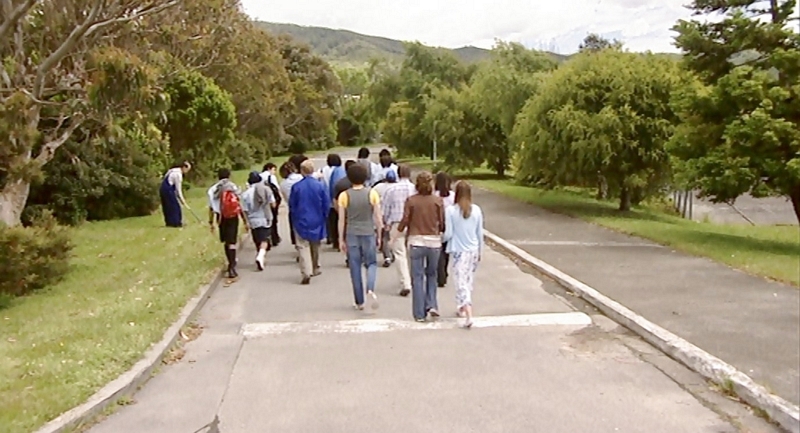
Closing image of Series 1. The boys and staff minus Steve, now empowered as Head of School, follow Gormsby, sacked by Steve and Marion’s strategem, down the drive in ambiguous tribute.
Directed by Danny Mulheron.
Writing Credits: Dave Armstrong, Danny Mulheron, Tom Scott.
First printed in Illusions, Number 40, Winter 2008, 47-50, here with illustrations added and a few revisions.