

Anchor me in the middle of your deep blue sea: Gaylene Preston, ‘Perfect Strangers’, and ambivalent romance
Anchor me in the middle of your deep blue sea: Gaylene Preston, Perfect Strangers, and ambivalent romance
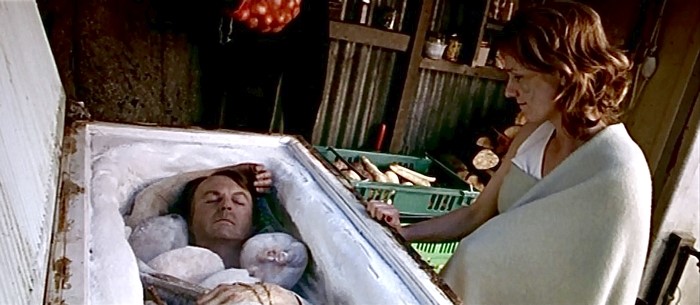
Gaylene Preston’s latest film Perfect Strangers (2003) was premiered along with films by two other New Zealand women, In the Cut by Jane Campion and Sylvia by Christine Jeffs at the London Film Festival in 2003. Jeffs’ rather mundane biopic need not concern us here, except symptomatically as bearing on the muted, sometimes hostile reception of Perfect Strangers in New Zealand. The Listener’s Philip Matthews, the country’s best film reviewer, in a big gesture for a small critical arena, prioritised Sylvia over Perfect Strangers on his influential review page (Listener, 31 Jan,2004), either a rare lapse of judgement or a result of the periodical’s prior coverage of Gwyneth Paltrow and her film (Listener, 17 Jan, 2004), making it difficult not to give it first billing, albeit that was like demoting Irene van Dijk to the bench to bring on a less lofty goal shoot.
Comparison with Campion and her film(s) is more interesting. In many ways the two film makers seem like perfect strangers themselves, a perception heightened by the refined gross-out, the delirious untrammelled sexuality of Campion’s sex and serial killing thriller. In the Cut (2003, the same year as Perfect Strangers) sends one back as far as her earliest films, like the strikingly perverse A Girl’s Own Story (1984), to check the intuition which Dana Polan expands in his recent book (1), that as a proponent of the Woman’s Film Campion the film maker – let alone her heroines – is considerably more narcissistically and masochistically unruly than much feminist criticism has allowed. Narcissism, masochism and unruly are not the most obvious terms to attach to Preston’s art.
The differences can be expanded. Campion moved away from New Zealand while Preston stayed. Campion has moved into international production with mega-stars like Meg Ryan and Nicole Kidman, while Preston has produced locally with actors for the most part known only to Australasian audiences (Sam Neill being the exception). Campion has worked exclusively in fictional film, while much of Preston’s output has been documentary, not just out of financial necessity, but because of her commitment to the mode. Whereas Campion is a major directorial star of the film world, Preston, though known to significant minorities outside New Zealand, is not.
Finally, while Campion’s work is marked by erotic fixation pessimism and masochism – underlined by that extraordinary title In The Cut with its wordplay on killer’s stab, cinematic suture, and a barely veiled ‘in the cunt’ – Preston’s has always suggested the pragmatic, the social, the outgoing, the community oriented. One of the many interests of Perfect Strangers is that it destabilises and complicates these antitheses, revealing Preston not as a Campion manque – she is a very different film maker – but, as it were, trying on for size her more famous sibling’s clothes.
A few words about those local reviews of Perfect Strangers. In early 2004 I read five: Peter Calder (Herald, 31 Jan), Barbara Sumner Burstyn (Herald, 16 Feb), Alex Spence (Sunday Star Times, 1 Feb), Graeme Tuckett (Capital Times, 11 Feb), and Matthews (Listener, 31 Jan). They divide two and two – Calder and Spence negative; Burstyn and Tuckett positive; with Matthews in between, an approval somewhat undermined by brevity and secondariness to Sylvia.
Despite their divergent reactions all the reviews agree that the film is ‘dark’, transgeneric, narratively unstable; Spence, who dislikes it, aptly articulates the narrative’s leap from ‘hostage thriller to hallucinatory love story’, Calder (very hostile) defines it not inaccurately as ‘a sort of metaphysical thriller’, Matthews picks up its gothic and fairytale lineage. The difference resides in whether the writers approve of its ‘oscillating’(Burton), its ‘alternating wildly in tone’ (Duckett very positively), or reject it as Calder does with his claim that it breaks the laws of plausible narrative and is ‘a cop-out and a cliché’. Calder’s claims of narrative discrepancies can’t for reasons of economy, be considered in detail here, but I would claim they are all either false perceptions, realistically explicable, or generated by generic category confusion. Arguably there are three basic underlying questions here: problems perceived in generic destabilisation; problems New Zealand critics and audiences seem to have with melodrama; and problems arising from expectations of Gaylene Preston’s work. All three of them probably contributed to the film’s rather negative local reception.
The first is very strange indeed since dominant narrative cinema is usually considered to be in an age of generic mixing, and New Zealand cinema is often seen as partaking of this. Whether this is true or not – think of Perry’s ‘antipodean camp’ as one attempt to claim it (2)- it is certainly an idea in circulation. Certainly, Perfect Strangers mutates from seemingly conventional female-in-jeopardy thriller inflected by the feminist variations of the sub-genre in Preston’s own earlier Mr Wrong (1985)and Melanie Read’s Trial Run ( 1984 ) to ghost or psychic spectre story also anticipated by Mr Wrong) and moves destabilisingly through modes as various as the gothic, the fairytale, the psycho-oneiric, comedy of the sexes, and, early on, the feminist – realistic. As to the last, think how perfectly the atmospheres of frustration are caught at the opening in the fish and chip shop where the girlfriends ponder the tabloid quiz – ‘Are you a sleaze or a tease?’). Should we really object to this (for me) exhilarating mixing?
As for the second ‘problem’, we may take ‘melodrama’ in its more general meanings of descending from drama with melos, of descending from 19th century stage spectacle, and its later, more refined, more interiorised manifestations, or of referring to Hollywood ‘family romance’, particularly the Woman’s Film, or perhaps some kind of composite of all of these. Either way, it is arguable that New Zealand critics and audiences – (literary as well as cinematic, think of the reluctance to grasp Devanny’s The Butcher Shop, 1926, and Mander’s The Story of a New Zealand River, 1920, for the extraordinary works they are) – find many of the manifestations of the mode hard to take, always excepting the talismanic instance of The Piano with all the force of its overseas renown.
Over the last few years such emotionally extreme and aesthetically ornate works as Memory and Desire (Caro,1998), When Love Comes ( Maxwell, 1999), Channeling Baby (Parker, 1999), and Maxwell’s earlier Jack Be Nimble (1993) have largely died a local death. There is a sequence in Memory and Desire where the nameless character played by Joel Tobeck (that somewhat down at heel Pakeha Everyman who is also the third party of Perfect Strangers’ triangle) is the drawn, sympathetic local spectator of the heroine Keiji’s heightened melodrama for which she selects her extreme New Zealand mise-en-scene of the local cinema’s original melodrama, Rudall Hayward’s My Lady of the Cave (1922). Seeing one of the watching surfies crudely parodying Keiji’s strange, keening dance, he rushes up and pushes at him angrily, a gesture which it is tempting to read not just as a critique of their insensitivity, but as an allegory of punishment for spectatorial incapacity. Perhaps aesthetic puritanism, preference for the laconic, suspicion of emotion, prioritising of realism, still run deeper in the culture than we think.
As regards the third ‘problem’, Preston, gregariously forthcoming in interviews, presents herself as a community artist, a “populist propagandist” (3), definitions which do indeed provide insight into her work. Her documentaries are often group-centred: the Masterton kids facing unemployment in Learning Fast (1980), the many focuses of Getting to Our Place (1995) the Te Papa museum documentary. This is a tendency even of documentaries following individuals: All the Way Up There (1978) is not just about the handicapped mountaineer, but the extended group that helps fulfil his ambition; The Making of Utu (1982) eschews the usual director-centred format; even the pieces on Hone Tuwhare (Hone Tuwhare, 1996) and Keri Hulme (Kai Purakau, 1987) have locals commenting on their famous neighbours’ works and Tuwhare in various social and institutional interactions giving a talk at a school and visiting the Balclutha Income Support Office.
Some of Preston’s work is explicitly attached to causes. The clever crime format documentary Hold Up (1981) with its handicapped witnesses condescendingly dismissed by the unhandicapped was made for the International Year of the Disabled. The Sonja Davies biopic Bread and Roses was linked to the centenary of Women’s Suffrage in 1993. This contrasts with Campion’s pretty much disowning the only short film she made in comparable circumstances, the sexual harassment project After Hours (4).
A superficial view of Preston’s output, extending to the most celebrated of her documentaries, War Stories Our Mothers Never Told Us (1995), and her three previous features, Mr Wrong (1984), Ruby and Rata (1989), and Bread and Roses (1993), along with the lapsed project to film Jean Betts’ gynocentric Hamlet rewrite, Ophelia Thinks Harder, might see it as unproblematically unified with only Perfect Strangers anomalously out on a limb.
Such emphases, unqualified, however, may construct too monolithic a version of an oeuvre more riven than Preston’s statements suggest. Undertexts of one kind or another abound. The Te Papa documentary surely has, running alongside its warm celebration of local pride and energy, a double perspective which includes satire of the bureaucrats, the chief of whom crows at one point “The most complete museum in the history of the world!” I pick this out to suggest that the oeuvre can be seen as too unrelievedly virtuous, whereas it is not immune to mischief, capable of subverting its affirmations, even its own subversions.
If the primary direction both of the features and documentaries favours the social over individual desires, Preston herself, talking of War Stories, registers the existence of a tension between the two in one of her finest films. After insisting on a socially oriented reading connected with the sexual double standard, as reflected in the interviewees’ experience, she then surrenders herself, as she imagines the audience does, to Pamela Quill’s story of unalloyed romantic love and death, with its love object looking, as the director notes, “like the young Marlon Brando” (5).
There’s nothing ever dull, puritan, or repressed about any of Preston’s constantly vibrant and inventive works, but it is true that, apart from the extraordinary opening to War Stories, the romantic-erotic is marginalised – for interesting purposes, but nevertheless marginalised. For instance, the feminist fable aspects of Mr Wrong render Meg’s “Mr Wright” marginal, and the really meaningful meeting of eyes takes place between Meg and Mary Carmichael’s ‘ghost’. In Bread and Roses, after her two youthful unions, Sonja’s marriage with Charlie has them both so widely committed to politics that they face living largely apart. Amusingly, the egotistically romantic Buckle becomes erotically redundant to Rata very quickly in Ruby and Rata. Yet at the same time the octogenarian Ruby effectively remakes herself as the seventh interviewee in War Stories with her (do we think invented?) story of the loss of her wartime soldier affianced pointing to undying desires of a kind displaced by others in their narratives.
It’s a defining virtue of Perfect Strangers’ abysmal romance – sexually cynical woman in dire job kidnapped by mad lover to deserted offshore island for extreme romantic ends, which, after accidentally (? ) killing him, she accedes to, painting a koru symbolising new life on her face, living domestically with and making love, like Keiji, with his ‘ghost’ – that it is so double-edged. A vein of scepticism, reduced but dormant in the won-over Mel, still surfaces. “Love will find a way”, Sam Neill, the nameless Man, says in a tender moment before his death. “Will it?” she replies, asks, hopes, denies
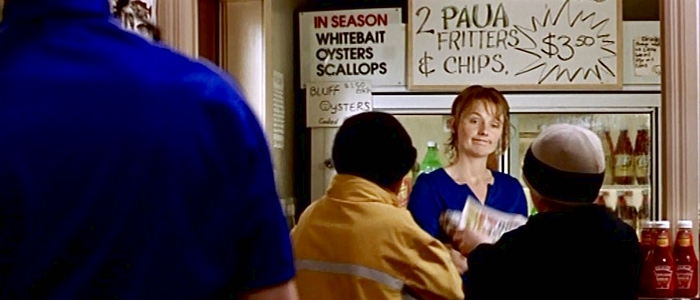
Mel’s (Rachael Blake) dead end job in the local chippie
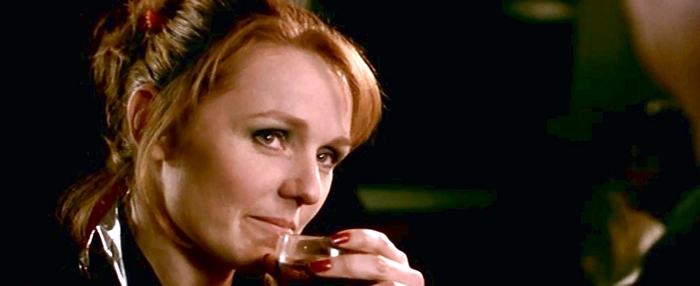
‘Some enchanted Evening…………………?’
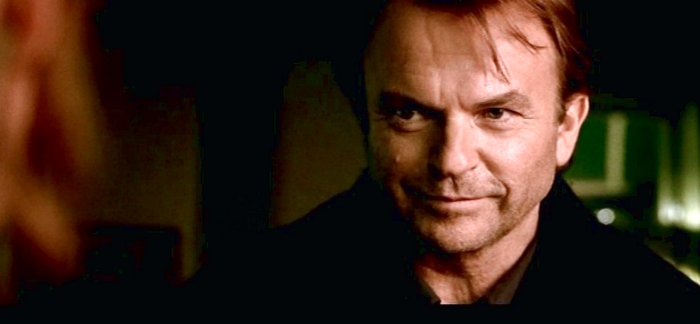
Mr Right and Mr Wrong (Sam Neill in one of his relatively few home roles in an international career)
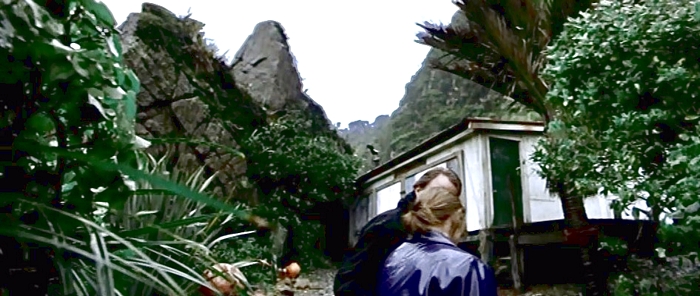
The Man and Mel arrive at his deserted offshore place / palace
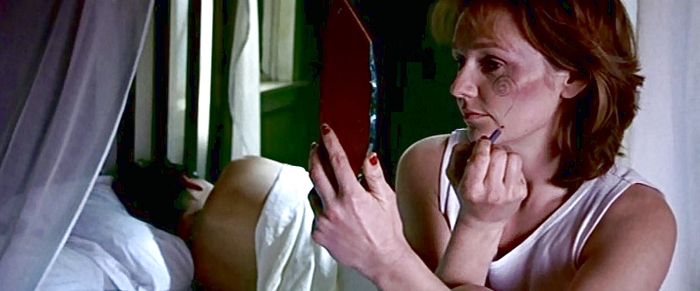
Sign of new life? Late in the film, after The Man’s death, Mel draws the koru motif (unfurling fern frond) on her face while her spectral lover sleeps
All this is accompanied by comic intrusions which insist even at the height of emotion on a degree of detachment in the audience. At one moment she tells the Man’s frozen corpse that she has to close the freezer in which he’s lying, but that later she’ll open the lid and he can do anything he wants. Then she hesitates and adds “within reason”. The comedy of this is based on the disparity between the excesses which she is already entertaining and whatever she and we can imagine to be beyond reason in the circumstances. If Perfect Strangers, in its invocation of amour fou, reminds one at times of Hollywood romances like Peter Ibbetson (Henry Hathaway,1935) and A Portrait of Jenny (William Dieterle, 1948) which cultivated redemptive fantasies of eternal romantic love, it must also be noted that such films deny the disruptiveness of comedy for an undisputed soulfulness. They embrace scepticism by suggesting the possibility that what the protagonists think happened may not literally have happened, that there is a divergence between internal and external worlds. But they leave no doubt that the heroes’ internal fantasies are approved as more ‘true’ than the external world’s rationalism.
Perfect Strangers, post-Freudian as well as post-Feminist, is of course more sceptical precisely in that, while giving sensuous, yearning weight to the pull of such fantasies, it inspects them with understanding and collusion, but also with incisive and unblinking irony. An example of this, kinetically full of shocks, yet delivered with that element of detachment and humour which pervades the film without destroying its oneiric fascination, comes when Melanie stitches up The Man’s wound without anaesthetics. When her maternal recommendation is to recite his times tables as distraction, he recites idealising love poetry by Denis Glover and Andrew Kinross (a late 19th century Scottish poet who emigrated to New Zealand), his uttering of their lines interspersed with gasps and visceral groans, injecting a dark, destructive subtext of pain and disintegration into the very syllables of ideality.
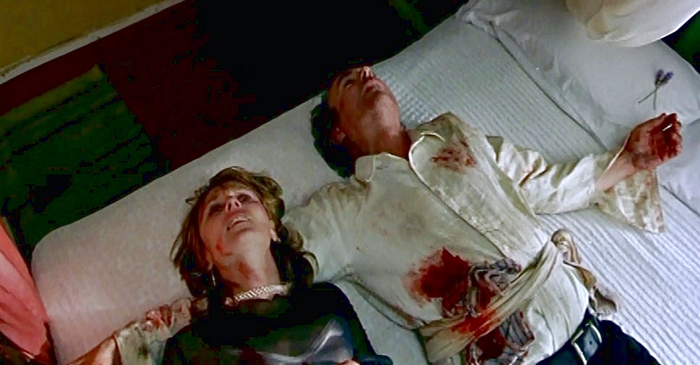
The bloodied couple after the stabbing
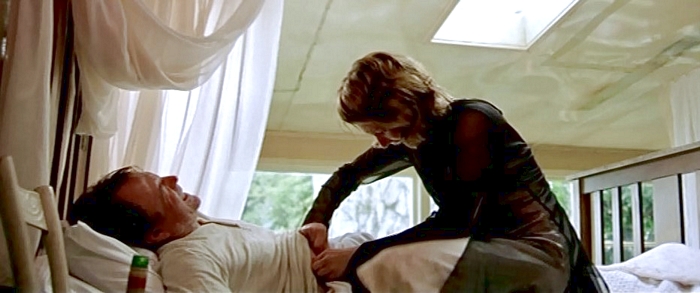
Mel sews up the fatal wound while The Man agonisedly recites local love poetry
In its way it is as affective and effective as those moments in Campion’s In the Cut involving Frances’ memory-fantasies of her parents’ ice skating romance where the skating husband severs his beloved’s legs, which in turn reminds one of The Man’s moments of psychotic rage in Perfect Strangers, the inverse of his idealism, his response to its denial.
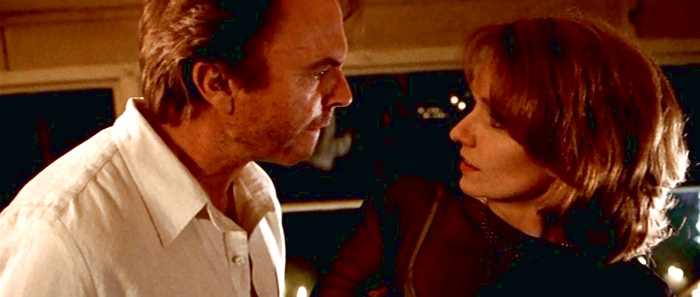
The Man’s threatening anger, accelerating into violence at Mel’s initial scepticism
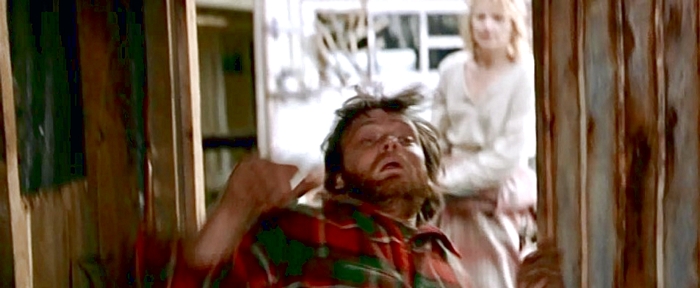
Capable of violence too when her posthumous idyll is threatened by Bill’s arrival, Mel knocks him out with a spade
There’s a fascinating instance of self-reference connected with Perfect Strangers. The Spring Summer 1985-86 issue of Alternative Cinema reprinted a prose piece by Preston called ‘Claude’s Circus: A Story of Modern Filmland’. It is a whimsical, aggressively proselytising piece that belongs to a formative moment in contemporary New Zealand film making when the masculine world of feature film was undergoing tremors of feminist assault. The second part of its revisionist fairy story begins:
Once upon a time on the edge of the world in a place called New Zealand a little girl called “Princess” was born. She was trained to be a Mother Princess. This meant that she learned to cook and sew, read and write (no one likes their wife to be stupid) and get used to the idea of always following her husband wherever his important work might take him.
Growing up, the cinema-going “Princess” “begins to understand that life isn’t at all like the movies”. She questions the roles of “King”, “Queen”, “Prince” and “Princess”. “Princess” now “Ms” becomes a film maker, believing “Now we can use this wonderful and powerful medium to help build a better world where people don’t have to be kings, queens, princes and princesses if they don’t want to”. But, of course, she finds it hard in the restricted, commodified world of television and film making. Putting aside her doubts caused by her rejection by television, she says to herself, “If my films are not marketable for the tv screens of the world, then I shall have to make a cinema feature. Maybe that way my ideas will affect a larger audience. Who wants to live happily ever after anyway?”
Does this ring a bell? In a memorable scene in Perfect Strangers her kidnapper tells her a story about “Princess Melanie”. Neglected by “the Queen” who sound awfully like a working mother and her Father, “the King” who is wholly occupied with concubines, “the lonely girl grew up wild and wanton. Many princes were her suitors and she pleased herself with all of them. A travelling troubadour [clearly Adrian, the rock band musician, who, as we learn in the narrative has abandoned the adult Melanie] stole her heart but then rode off into various sunsets, leaving her slaving in the kitchen [ the dire fish and chip shop where we see Melanie working in the film’s first sequence]. Dumped there. Poor lonely girl. The Man then finishes the story by relating how not a prince but an ordinary man blows in on a dark and stormy night and takes her to his castle “where they fell in love and got married and lived happily ever after”.
All this suggests something rather more complicated than either of two reductive explanations: that Princess Story 1 is a document we can simply use to deconstruct Perfect Strangers’ eerie romance, or that Princess Story 2 reveals a Preston who has grown out of the simplicities of Princess Story 1. Whatever else may be said, by the end both Melanie and her ‘Mr Right/Wrong’ are mad, at the ‘fou’ extreme of ‘amour fou’, while Bill (Joel Tobeck) the rejected suitor who in the plot’s coda Melanie marries in order that he will hide her killing of The Man must, despite his naivete have a few clues as to what is going on, is not much better.
At the same time the situation plunges into a vortex of psychic desires, frustrations, ambivalences, demands, that are not exactly amenable to rational deconstruction and palliative action (like making feminist films?) It also invokes other New Zealand films that tend in the same direction like Memory and Desire, already mentioned, and Alison MacLean’s famous short, Kitchen Sink (1989).
One of the differences in Princess Story 2 is that it calls up the intimate family romance, which Princess Story 1, brusquely concentrating on other things, doesn’t, and by doing so sets up a scenario less amenable to amelioration of the loss and abandonment (Mother, Father, Troubadour Lover) that we recognise as pushing the psyche back both to childhood helplessness and the unsatisfiable psychic desires of the child and the child within the adult.
There is a moment charged with meaning when Mel, having dressed herself in the beautiful clothes the man has left for her, emerges and stands in an unmistakeable little-girl-in-party-frock-asking-for-approval pose, hands poised coyly in front of her, eyes cast down but still observing. Here as elsewhere in Rachael Blake’s performance and Preston’s capturing of it there are extremely subtle effects, one being that there’s no attempt to hide that Mel is an experienced thirty-something. The effect in her pose of the child in the adult, at the same time touching, analytically accurate as regards universal narcissism, and slightly grotesque, captures a lot of psychic complexity. As indeed does the way both characters, she and The Man, minister to the mixture of child and adult in the other, with Melanie seeming never happier than when The Man is wounded and helpless and her maternal feelings are given a focus, as when she forks food into his mouth cooing, “Here comes the choo choo train, toot toot!”
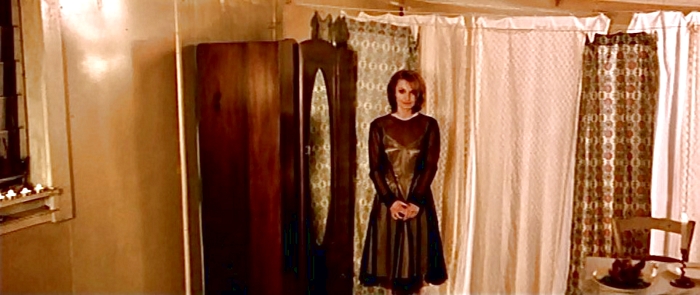
Mel comes out of the bathroom like a little girl in her party dress posing for approval
I have no idea of the extent or direction of Preston’s early psychiatric therapy training, but Melanie’s penchant for substitutions, her use of Bill after The Man dies, her speaking of The Man at one point as her “thing” – meaning I take it that he is an instrument that takes various forms – are all elements that send me to the central pages of Freud’s discussion of Narcissism as well as to the opening of Campion’s Portrait of A Lady with its young contemporary girls discussing kissing and love objects with spectacularly undiluted narcissism (6).

Melanie bathing in candlelight as arranged by The Man with ecstatic Puccini commentary
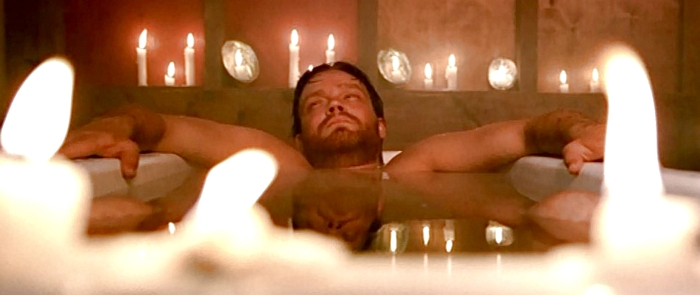
Bill (Joel Tobeck) placed by Melanie in the same candlelit scenario
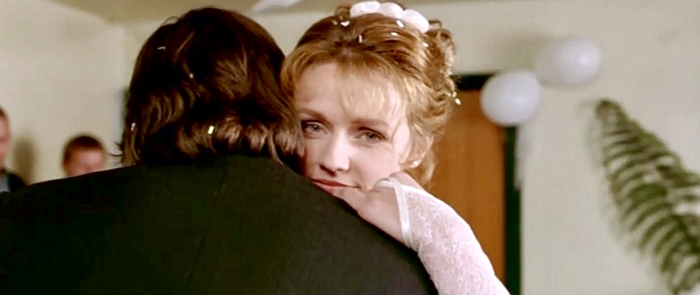
Dancing at her wedding to Bill that ends the film Mel looks over his unsuspecting shoulder at her spectral spouse
The exuberant formal flourishes of Perfect Strangers’ trickily deceitful opening are the statement of a film maker, perhaps a little chafed by being taken as an exemplar of transparency, straightness and what-you-see-is-what-you-get, that not everything may be as it seems.
Over an imageless dark screen, mysterious, largely indecipherable and unlocatable sounds are heard: something like soft percussive brushings followed by a deeper, punctuating thud, repeated several times, intermixed with equally unlocatable female (?) breathing noises, suggestive perhaps of crying? Or sex? These resolve into the narrative’s opening image, a close- up of a knife chopping an onion, both held by hands with deep blood-red fingernails, forcing reinterpretation of the distorted sonics in line with the image now seen as generating them – mundane yet somehow still estrangingly threatening. A cut to a close medium shot from a slightly distorting high angle presents Rachael Blake in a seeming rictus of emotion which, however, has to be mundanely, ironically interpreted as the physiological effect of the onions. Again, though, the image retains an excess of melodramatic meaning that lingers as a prefiguration of dark forces of desire, not just as their reduction.
Don McGlashan’s “You’re Not the Girl You Think You Are” is used ironically in the film as regards the discoveries Mel (the name Melanie signifying darkness, blackness) makes in herself. It could also be taken as commentary on Preston’s ability to surprise the viewer (and even perhaps herself) in her new film.
NOTES
1. Dana Polan, Jane Campion, London, BFI Publishing, 2001.
2. Nick Perry, ‘Antipodean Camp’, Hyperreality and Global Culture, New York, Routledge, 1998, pp. 4-23.
3. Keith Beattie, ‘First Say and Last Cut: A Conversation with Gaylene Preston’, New Zealand Journal of Media Studies, vol. 3, no. 2, 1994,pp.4-13:4.
4. Polan, op.cit., p.77.
5. Beattie, op.cit., pp. 9-10.
6. S.Freud, ‘On Narcissism: An Introduction’, The Theory of Psychoanalysis, Pelican Freud Library, vol 11, Harmondsworth, Penguin, 1984, pp.80-85.
—
First printed in Illusions: New Zealand Moving Image and Performing Arts Criticism, No.36, 2004. Reprinted with a few small textual additions left out of the original for reasons of economy and the substantial addition of frames from the film.